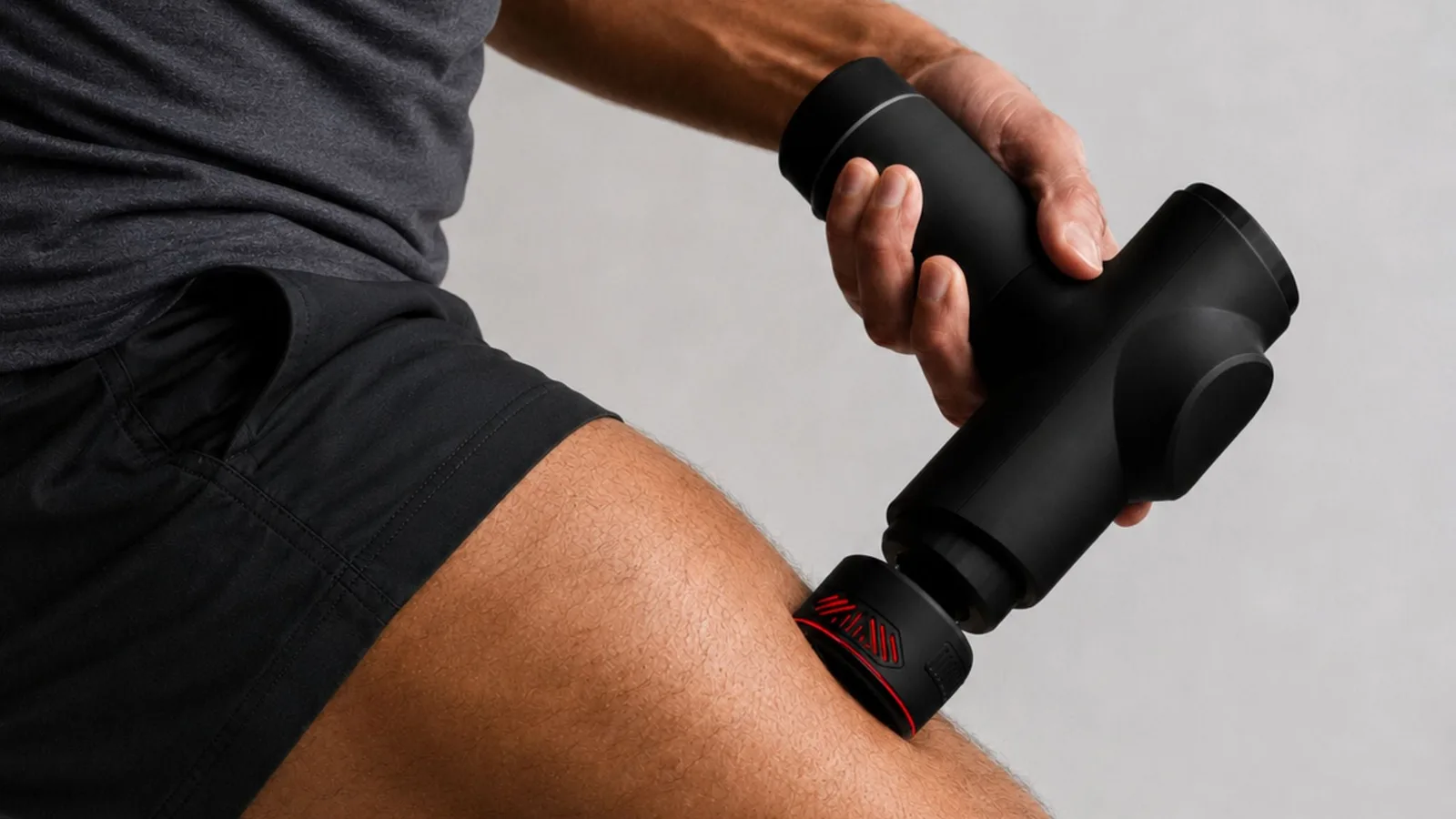
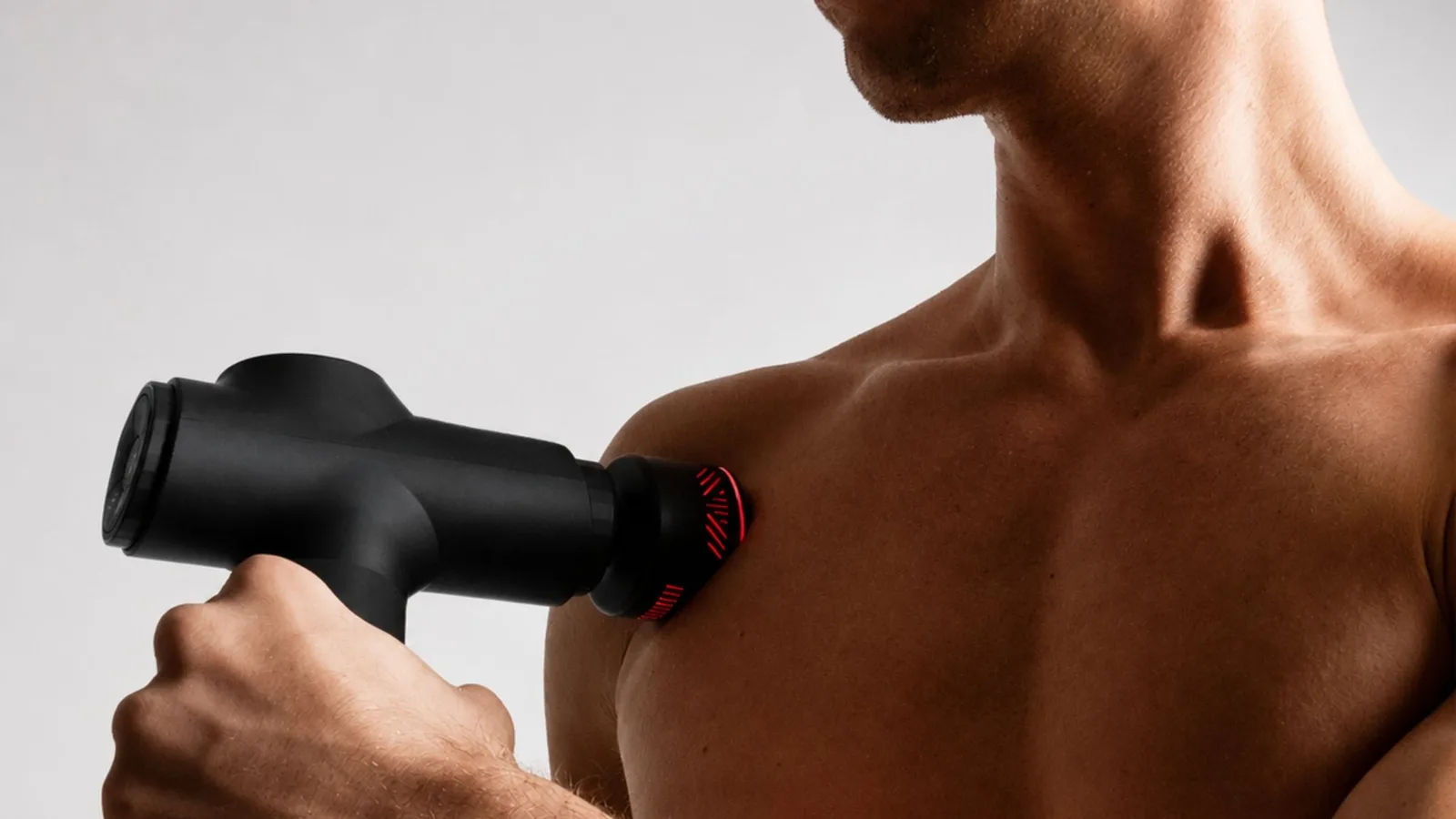
Massage gun for your back: upper and lower back done right
Using a massage gun on your lower back means working only on the muscle either side of the spine, never on the vertebrae, and much more gently than on the upper back. This is where most people go wrong: too much pressure, the wrong attachment, or trying to massage away a painful back.

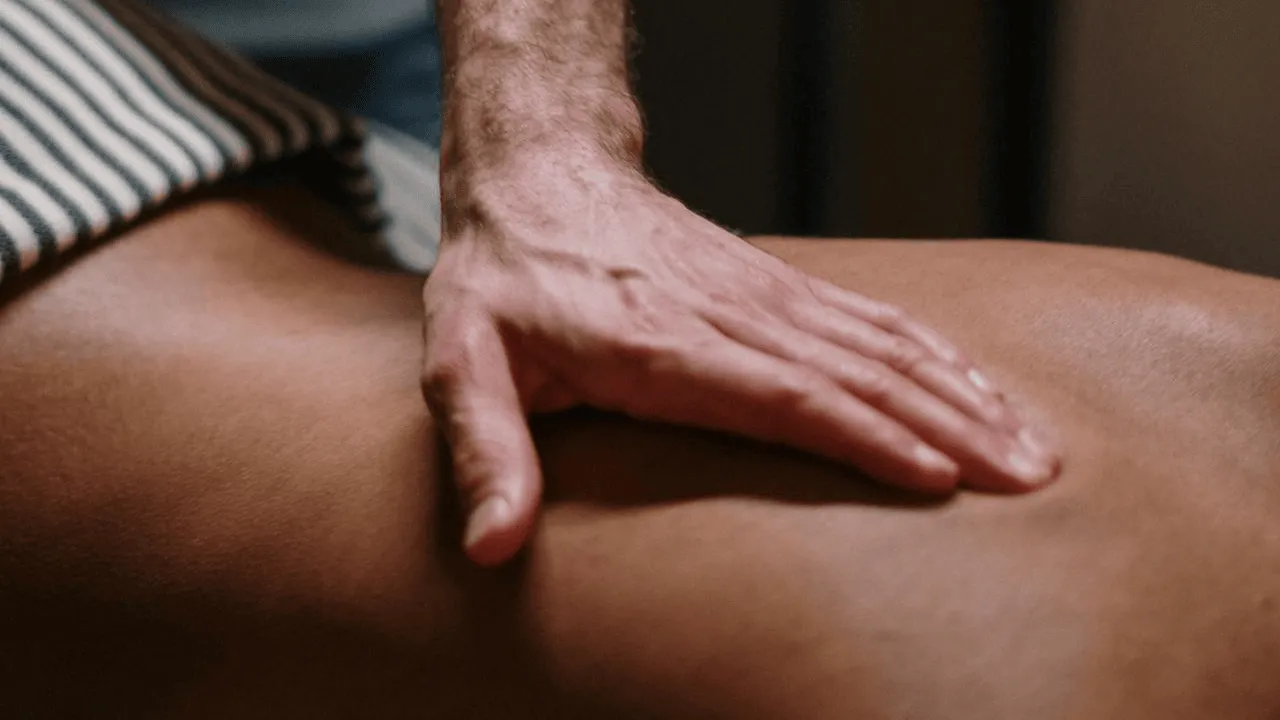
In this guide I show you which muscles you can reach in the upper and lower back, which attachment and speed to use and how long to stay. I am also straight with you about what the research says massage does for back pain, and when it is time to see your GP instead.
This article takes our main guide how to use a massage gun and applies it to one region: the back. The general rules on time, pressure and attachments are there. Here it is about which back muscles you can reach, how the upper and lower back need different handling, and where the line is.
01. Which back muscles can you treat with a massage gun?
Your back is not one muscle but several layers. For a massage gun, these matter most:
- Upper trapezius: between neck and shoulder, the area that tightens after long hours sitting and overhead pressing.
- Middle trapezius and rhomboids: between the shoulder blades, typically tight after rows, pull-ups or a long day at the desk.
- Latissimus dorsi: the broad muscle on the side of the trunk below the armpit.
- Erector spinae: the two columns of muscle running either side of the spine from pelvis to neck. You feel them after deadlifts and squats.
What does not count: the spine itself, meaning the bony bumps down the middle, the ribs directly, and the area on the side of the lower back towards the flank. The kidneys sit there and the muscle is thin.
02. Upper back: how to do it
The upper back tolerates the most. The muscles lie over the shoulder blades and ribs, have decent bulk and no sensitive organs right underneath.
- Attachment: ball head for the area between the shoulder blades, fork head for the erector spinae along the upper spine.
- Speed: start on 1 and go to 2 if it stays comfortable.
- Switch on first, then apply. Place the head flat and glide in slow strokes from bottom to top without pressing.
- Time: 60–90 seconds per side. Hold tight spots between the shoulder blades for 10–20 seconds at most.
- Upper trapezius: speed 1 only, 30–60 seconds per side, and never forwards or sideways onto the throat.
The neck itself has its own guide: massage gun for neck tension. If percussion on the shoulders and neck feels too strong, our comparison Vibra Grip or massage gun covers a gentler option.
03. Lower back: more care than up top
Stricter rules apply lower down. There are no ribs under the erector spinae here, the muscles are narrower and the kidneys sit to the side.
- Attachment: the flat head, or the fork head positioned so the spine runs between the prongs.
- Speed 1 and no extra pressure.
- Work straight up and down beside the spine, about two fingers' width from it, not out towards the flank.
- Time: 30–60 seconds per side.
- Then the glutes: 60–120 seconds per side with the ball head on speed 2. Many people with a tight lower back sit a lot and have tight glutes too. How to find the tight spots there is covered in finding trigger points in the glutes.
04. Back protocol at a glance
| Area | Attachment | Speed | Time per side |
|---|---|---|---|
| Upper trapezius | ball or flat | 1 | 30–60 seconds |
| Between the shoulder blades | ball, briefly bullet | 1–2 | 60–90 seconds |
| Erector spinae, upper back | fork | 1–2 | 60 seconds |
| Latissimus dorsi | ball | 1–2 | 60 seconds |
| Lower back | flat or fork | 1 | 30–60 seconds |
| Glutes | ball | 2 | 60–120 seconds |
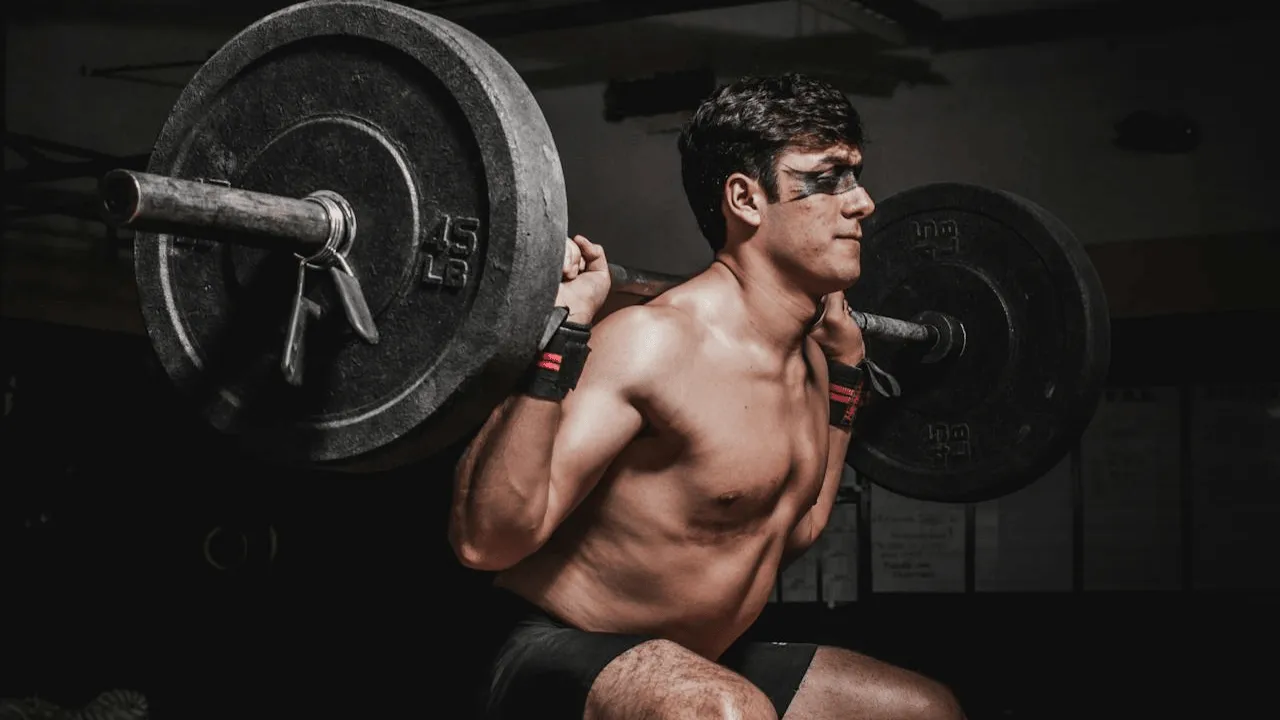
Before training, half the time on a low speed is enough. After heavy deadlift or squat sessions, go gently or save it for the evening or a rest day. Why timing matters is explained in massage gun before or after a workout.
05. How do you reach your own back?
You can reach the upper trapezius and lower back yourself without much trouble. Hold the handle loosely, sit or stand, and guide the gun with a bent elbow. Between the shoulder blades it gets awkward: twisting to get there tenses exactly the muscles you want to relax. A partner is the better solution here. Lie face down and let them guide the gun without pressing. Show them first where your spine runs and where to stop.
"After heavy deadlift days I get my back done in the evening on speed 1 with the fork head, two minutes, no more. For me, half the effect comes from the glutes, not the back itself."
06. Does a massage gun help with back pain?
Honesty matters here. Most back pain has no specific cause and settles within a few weeks. The NHS advises staying active and keeping up your daily routine, because long periods in bed are not recommended. Heat packs may help with stiffness, and back exercises and stretches are worth a try as long as the pain does not get worse.
On massage there is a 2015 Cochrane review (Furlan et al.) of 25 trials with more than 3,000 participants. Massage eased low back pain in the short term, with hardly any effect in the long term, and the authors say they have very little confidence in the results because the evidence was of low quality. Only three of the trials used a device at all. There are no dedicated studies on massage guns for the back. What we know comes from other muscles: a short-term gain in mobility without loss of strength (Konrad et al. 2020, Ferreira et al. 2023).
For you, that means the gun is a tool to loosen a back that is tight after training. It is not a treatment for back pain and replaces neither movement nor a diagnosis.
Get it checked straight away
If back pain follows an accident or fall, comes with numbness, tingling or weakness in the legs, changes in bladder or bowel control, fever or feeling generally unwell, gets worse quickly or at night, or has not improved after a few weeks, it belongs with your GP or A&E, not under a massage gun.
07. Where a massage gun does not belong on your back
- on the spine and the bony bumps of the vertebrae
- directly on the ribs, especially on the side of the ribcage
- on the side of the lower back towards the flank (kidney area)
- on the shoulder blade bone and its edge
- with acute severe pain, fresh strains or bruises
- after back surgery without your doctor's go-ahead
A 2021 case report (Chen et al.) shows that too much can have serious consequences: a young woman developed rhabdomyolysis, a severe breakdown of muscle tissue, after cycling followed by a massage gun session. One case, but a clear signal: pain and bruising are warning signs, not a training effect. If you take blood thinners, have osteoporosis, an implant or nerve damage, or are pregnant, check with your GP before using one.

Revive Pulse Pro massage gun
5 speeds, 5 attachments including a fork head and a heat/cool head, 3–4 hours of battery.
08. Who is a massage gun for the back for, and who not?
A good fit for lifters after deadlifts, rows and squats, rugby players after contact sessions, rowers, climbers, Hyrox athletes after sled pushes and wall balls, and anyone whose upper back feels tight after a long day at the laptop. Where the gun fits into a full training week is covered in the recovery protocol for bodybuilding and lifting and in the guide to Hyrox recovery between training blocks. The heat attachment of the Revive Pulse Pro works well before training when your back feels stiff.
Not suitable with acute back pain radiating into the leg, disc problems without medical clearance, osteoporosis, or for anyone trying to "push through" pain with the gun. If you prefer a gentler, more precise approach, have a look at vibration massage as an alternative; its vibration also belongs on muscle only, never on the spine.
Conclusion
On your back, use a massage gun only on the muscle either side of the spine: on the upper back with the ball or fork head at speed 1–2 for 60–90 seconds, on the lower back with the flat head at speed 1 for 30–60 seconds, and do the glutes as well. That suits athletes and desk workers who want to loosen a back that is tight from training or sitting. For back pain, research shows only short-term effects of massage, staying active matters most, and warning signs need a doctor straight away.
Frequently asked questions
Can you use a massage gun on your spine?
Is a massage gun good for lower back pain?
How long should I use a massage gun on my back?
Which massage gun attachment is best for the back?
How do I use a massage gun on my own back?
When should I not use a massage gun on my back?
Sources
- Furlan, A. D. et al. (2015). Massage for low-back pain. Cochrane Database of Systematic Reviews, (9), CD001929. – 25 trials, 3,096 participants
- NHS: Back pain. Page last reviewed 5 March 2026.
- Konrad, A. et al. (2020). The Acute Effects of a Percussive Massage Treatment with a Hypervolt Device on Plantar Flexor Muscles' Range of Motion and Performance. Journal of Sports Science and Medicine, 19(4), 690–694.
- Ferreira, R. M. et al. (2023). The Effects of Massage Guns on Performance and Recovery: A Systematic Review. Journal of Functional Morphology and Kinesiology, 8(3), 138.
- Chen, J. et al. (2021). Rhabdomyolysis After the Use of Percussion Massage Gun: A Case Report. Physical Therapy, 101(1), pzaa199. – Case report of a serious adverse event
- Ractiveone: Revive Pulse Pro specifications (5 speeds, 5 attachments incl. fork head and heat/cool head), as of 15 Oct 2026.