Evening routine for better recovery: the last 60 minutes before bed
A good evening routine for better sleep does not need two hours or twelve steps. It needs one fixed hour in which light, body temperature and your head switch to night mode. That is where the research is: even dimmed room light holds back the sleep hormone melatonin less, and a warm shower one to two hours before bed shortened the time to fall asleep in a meta-analysis.

Here is the 60-minute plan I use as an athlete, split into what is backed by evidence, what simply feels good, and where compression boots, heat and blue light glasses fit in.
Why sleep is the most important recovery factor for athletes is covered in sleep and muscle recovery. This guide is the practical part: what you actually do in the last hour before bed. The background on evening light and melatonin is in blue light and sleep: what the studies show, so I will link to it rather than repeat it.
Why focus on the last hour before bed?
Because two things happen in that window that you can influence directly. Your body ramps up the sleep hormone melatonin, and your core temperature drops. Both respond to what you do. Light holds melatonin back, even at levels you would find in an ordinary living room. In a 2019 study (Phillips et al.), about 25 lux on average was enough to halve its release. People who read on a backlit tablet in the evening instead of a paper book fell asleep later and were less alert the next morning (Chang et al. 2015).
Temperature you can use by warming up briefly first. Your body then sheds the heat through your hands and feet, and core temperature falls faster. That is the idea behind the warm shower below.
The 60-minute plan at a glance
| Time before bed | What you do | Why |
|---|---|---|
| 6 hours or more | no more caffeine, including pre-workout | 400 mg still disturbed sleep after 6 hours (Drake et al. 2013) |
| 1 hour or more | hard session finished | only very hard sessions just before bed disturb sleep (Stutz et al. 2019) |
| 60 minutes | dim the lights, warm shower, humidifier on in the bedroom | fewer lux for melatonin, warmth for the temperature drop |
| 50 minutes | blue light glasses on if screens are still running | filters the light you cannot dim |
| 45 to 20 minutes | compression boots or heat on neck and shoulders | quiet time lying down, lighter legs after training |
| 15 minutes | into bed, paper instead of screens, phone out of reach | no new light source, no new input |
Step 1: How do I dim the lights properly?
Main light off, one or two warm lamps on, ideally below eye level. This is the most effective step of the whole routine and it costs nothing. Night mode on your phone only shifts the colour of one screen. If the TV, laptop or console stays on, that is where the red blue light glasses for the evening come in. According to the manufacturer they filter 100 % of blue light and are meant for the last one to two hours before bed. What the evidence says: tinted lenses weaken the light's brake on melatonin, but a Cochrane review does not consider better sleep proven. So I see the glasses as an add-on to dimming, not a replacement. Which tint suits which time of day is covered in red vs orange blue light glasses. If you are still working on a laptop late, read our piece on screen time, eyes and sleep.
Step 2: Why a warm shower in the evening helps
A 2019 meta-analysis (Haghayegh et al.) reviewed 17 studies on warm showers or baths before bed. With water at 40 to 42.5 °C, one to two hours before bedtime, people fell asleep faster and rated their sleep better. About ten minutes was enough. The authors stress that the data are limited, especially on the best timing and duration. For me it is still the step with the best ratio of effort to evidence. You shower after training anyway, so move it to the start of the routine.
Step 3: Get the bedroom ready
Dark, quiet, on the cool side. During the heating season, humidity comes into it too: many people find dry, centrally heated air uncomfortable on the throat and eyes at night. I switch on the Aero Pure Deluxe in the bedroom when I start the routine. The manufacturer quotes under 35 dB and an automatic shut-off when the tank runs dry. Which values to aim for, and why too much moisture is a problem, is covered in ideal bedroom humidity for sleep. If you like a scent, a few drops of essential oil in the tank are enough. Dosing is explained in how to use essential oils in a humidifier.
Step 4: Compression boots or heat, 20 to 30 minutes
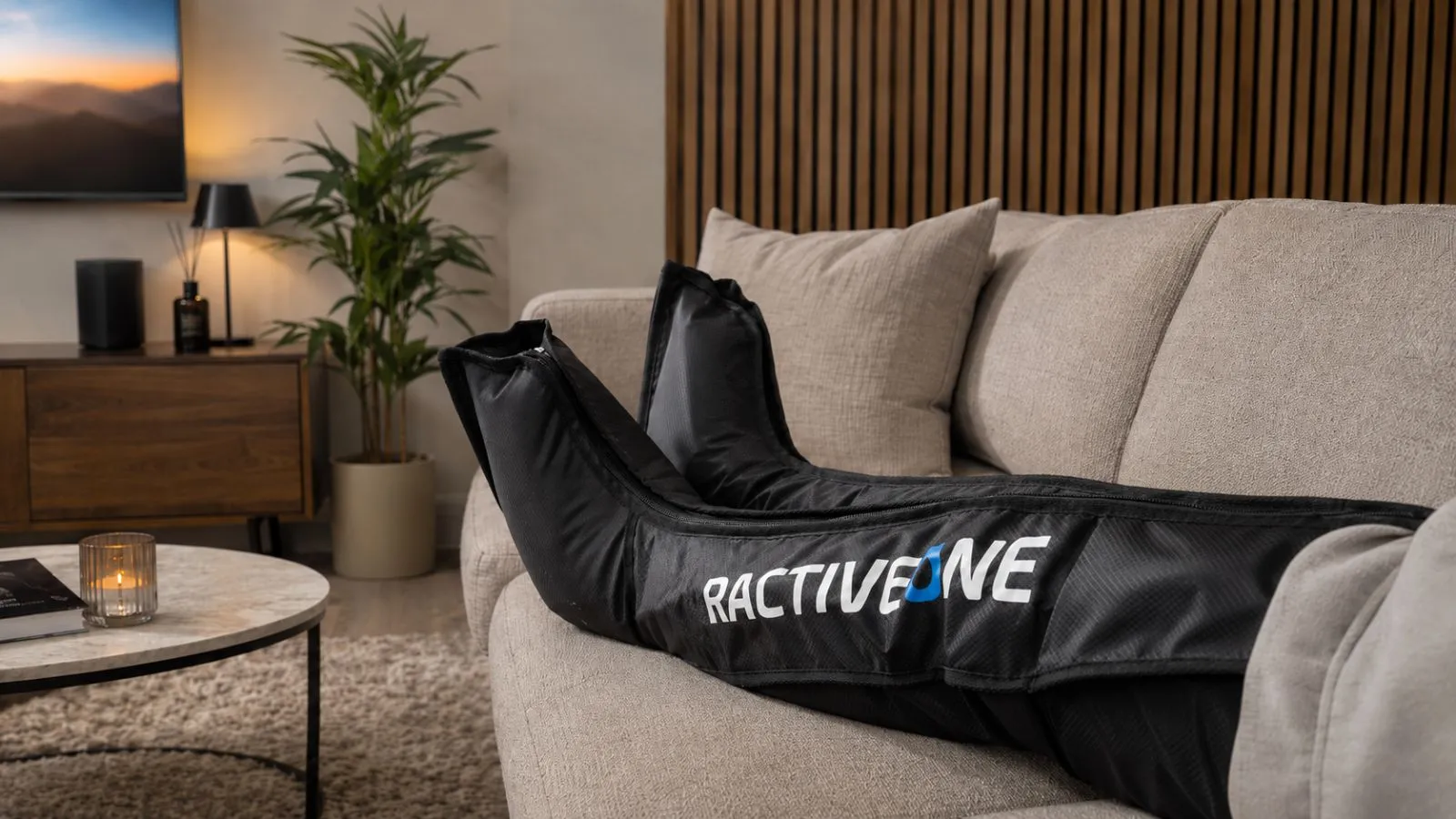
This is the part I look forward to most after leg day. I lie on the sofa, put the boots on and set 30 minutes, or 15 on rest days. In the evening I use a low pressure level and a gentle mode such as the wave. The Revive Active with 7 pressure levels and 5 modes has a timer, so the session ends on its own. How to choose duration, pressure and frequency otherwise is covered in how to use compression boots.
To be clear: no study shows that compression boots improve sleep. What they give you is legs that feel better after hard sessions and half an hour of lying still instead of scrolling. That is exactly what makes them a good evening habit.
If your upper back is tight rather than your legs, I use heat. The Thermo Flex with three heat levels straps onto your neck or shoulder and leaves your hands free. Fifteen to twenty minutes on the middle setting is plenty. Which heat source works best on the neck is compared in heat for neck tension. When heat is the better choice and when cold is, see heat or ice for sore muscles. In the evening I only use heat, never cold, because I want to wind down.
“The routine works for me because it never changes. Shower, lights down, boots, bed. I do not have to think about it, and after a few weeks my head knows that once the boots come off, screens and training plans are done for the day.”
Fabian, professional bodybuilder and coachWhat does not belong in an evening routine?
- Alcohol as a sleep aid. According to a review (Ebrahim et al. 2013), alcohol helps you drop off faster, but the second half of the night gets more broken. A poor trade for recovery.
- Late hard sessions with no buffer. Evening training is usually fine, but keep the last hour before bed calm (Stutz et al. 2019).
- Emails, training plans and social media in bed. New input keeps you awake, whatever the light.
- Falling asleep in the boots. Set the timer and take them off before you sleep.
- A different routine every night. The expert consensus on athlete sleep (Walsh et al. 2021) relies on fixed routines and fixed times.
The short version for busy days
If you only have 20 minutes: dim the lights, glasses on, phone away, bed. Skip the shower and the boots that night. Doing the short version every day is worth more than the full routine once a week.
Who the routine suits, and who it does not
A good fit if you
- train in the evening and struggle to switch off afterwards
- spend a lot of your evening on screens
- have heavy legs after leg day, a long run or a football match
- want a clear line between day and night
Not suitable, or check with a doctor first, if you
- have slept badly for weeks. See your GP; no routine treats a sleep disorder.
- have had a blood clot, have a heart condition or are pregnant. Get medical advice before using compression boots. All the reasons are listed in when not to use compression boots.
- have a fresh injury with swelling. No heat on that spot.
- still drive in the evening. Strongly tinted lenses are not made for that.
Conclusion
An evening routine helps recovery mainly through two well-supported levers: less light in the last hour and a warm shower one to two hours before bed. Athletes who train late or spend long evenings on screens benefit most, as long as they repeat the same routine every night. Compression boots, heat, blue light glasses and a humidifier make the evening more pleasant and easier to stick to, but a direct effect on sleep has not been shown for them, and ongoing sleep problems belong with a doctor.
Frequently asked questions
What is a good evening routine for better sleep?
When should I shower at night to sleep better?
Can I use compression boots right before bed?
Does a glass of wine help you fall asleep?
How late can I train in the evening?
When should I put on blue light glasses in the evening?
Sources
- Haghayegh, S. et al. (2019). Before-bedtime passive body heating by warm shower or bath to improve sleep: A systematic review and meta-analysis. Sleep Medicine Reviews, 46, 124–135.
- Phillips, A. J. K. et al. (2019). High sensitivity and interindividual variability in the response of the human circadian system to evening light. PNAS, 116(24), 12019–12024.
- Chang, A.-M. et al. (2015). Evening use of light-emitting eReaders negatively affects sleep, circadian timing, and next-morning alertness. PNAS, 112(4), 1232–1237.
- Stutz, J., Eiholzer, R. & Spengler, C. M. (2019). Effects of Evening Exercise on Sleep in Healthy Participants: A Systematic Review and Meta-Analysis. Sports Medicine, 49(2), 269–287.
- Drake, C. et al. (2013). Caffeine effects on sleep taken 0, 3, or 6 hours before going to bed. Journal of Clinical Sleep Medicine, 9(11), 1195–1200.
- Ebrahim, I. O. et al. (2013). Alcohol and sleep I: effects on normal sleep. Alcoholism: Clinical and Experimental Research, 37(4), 539–549.
- Walsh, N. P. et al. (2021). Sleep and the athlete: narrative review and 2021 expert consensus recommendations. British Journal of Sports Medicine, 55(7), 356–368.
- Singh, S. et al. (2023). Blue-light filtering spectacle lenses for visual performance, sleep, and macular health in adults. Cochrane Database of Systematic Reviews, 8, CD013244.
- Ractiveone: Revive Active, red blue light glasses, Thermo Flex and Aero Pure Deluxe (manufacturer information)