Heat or ice for sore muscles? What works after training
Heat or ice for sore muscles? In short: use heat for stiff, tight muscles and for soreness the day after, and use cold straight after a hard session or when you need to perform again soon. A meta-analysis of 32 trials found that both reduce muscle soreness, with no clear winner between them.

What matters is timing, duration and what you are training for, not which one feels nicer in the moment. This guide gives you a decision table for common situations, practical temperatures and minutes, and explains when regular icing can work against your strength gains.
Heat or ice is one of the questions I hear most often after a session, usually from someone holding a bag of frozen peas in one hand and a hot water bottle in the other. Both can be right, just not in every situation. This article is part of our complete guide to recovering after a workout and brings together what you need to know about heat, cold and alternating the two.
One honest point first: the evidence is thinner than adverts and social media suggest. Many studies are small, and most test water baths or heat wraps rather than devices. Where the research is clear, I will say so. Where it is not, I will say that too.
Heat or ice: the short answer
Heat helps most with stiff, tight muscles and with soreness from the day after. Cold fits straight after a hard session, within the first hour, and when you need to be ready again the same or next day. With a fresh injury that is swollen, neither is the answer; get it assessed.
That rule of thumb matches the largest review on the topic. Wang and colleagues pooled 32 randomised trials with 1,098 participants in 2021. Cold applied within an hour of exercise reduced soreness over the first 24 hours; after that, no clear effect was measurable. Heat reduced pain both within and beyond the first 24 hours. The authors found no significant difference between heat and cold overall.
Cold is a tool for the first few hours. Heat is a tool for tight muscles and the days after. Neither replaces sleep, food or a sensible training plan.
What do heat and cold actually do to a muscle?
Cold narrows the blood vessels in the skin and surface tissue. Blood flow drops, local metabolism slows and nerves pass pain signals more slowly, which is why cold feels so good on an acute ache. Heat does the opposite: vessels widen, blood flow rises and connective tissue becomes more extensible. A review by Malanga and colleagues (2015) describes exactly these mechanisms, but also points out that most recommendations rest on experience rather than strong trials.
Cold: numb and calm
Cold reduces pain, blood flow, swelling and muscle spasm. For athletes the pain relief is the interesting part: after a match or a hard interval session, legs feel fresher sooner. That is not a placebo, but it is not a healing accelerator either. Cold mainly changes how the muscle feels.
Heat: loosen and increase blood flow
Heat increases blood flow and tissue metabolism and makes muscles and tendons more pliable, which is why it helps with tension and stiffness. A study by Petrofsky and colleagues (2017), with three groups of 20 people, found the least soreness after heavy squats in the group that received a low-level heat wrap straight after training. That wrap stayed on for 8 hours, though, so the result cannot be transferred one to one to a 20-minute session.
When to use heat and when to use ice: the decision table
The table covers typical situations from training and match days. Times for local use follow the usual 15–20 minutes per session; the ice bath figures follow the meta-analysis by Machado et al. (2016).
| Situation | Better choice | Duration and notes |
|---|---|---|
| Straight after a hard session or match (first hour) | Cold | 15–20 min locally, or 10–15 min in water at 10–15 °C |
| Sore muscles the day after | Heat | 15–20 min locally, can be repeated during the day |
| Tight shoulders or back, no injury | Heat | 15–20 min, then move gently |
| Stiff muscles before training | Heat | 10–15 min, then a normal warm-up |
| Tournament or two sessions in one day | Cold or contrast | Between sessions; avoid cold right before sprinting |
| Building strength and muscle | Heat or active recovery | No routine intense cold straight after lifting |
| Fresh injury with swelling or bruising | Neither | Get it assessed; no heat in the first days |
Heat or ice for DOMS?
With delayed onset muscle soreness, the answer depends on timing. In the first hour after training, cold can take the edge off the next 24 hours. Once the soreness has set in, usually 24 to 72 hours after unfamiliar exercise, heat is the better choice. It feels more pleasant and, in the Wang et al. (2021) meta-analysis, it also reduced pain beyond the first day.
For context: DOMS comes from small amounts of damage in the muscle after unaccustomed, mainly eccentric work, such as downhill running, deep squats or your first sprints after a break. Neither heat nor ice undoes it. They make the following days easier. Other levers, from movement to sleep, are covered in our 9 tips to reduce muscle soreness.
Heat or ice for muscle tension?
For tension, such as a tight upper back after a day at the desk or stiff shoulders after overhead work in the gym, heat is the first choice. Tense muscles feel hard and poorly supplied with blood, and heat works exactly there. For acute and sub-acute back pain, a Cochrane review (French et al. 2006) found a small, short-term improvement in pain and function with heat wraps, especially combined with exercise. For cold, the data were too thin to draw conclusions.
In practice: 15–20 minutes of heat, followed by a few easy movements such as shoulder circles or gentle mobility. Heat on the sofa alone helps less than heat plus movement. Which heat source suits a stiff neck best is compared in heat for neck tension. For stubborn spots around the neck and shoulders, targeted massage can add to this. How to do that with a massage gun is explained in relieving neck tension with a massage gun.
"Plenty of athletes put ice on a tight neck because cold sounds like sport. With tension and no injury, though, cold works against the goal: the muscle should relax, not tighten further. In those cases I reach for heat almost every time."
Does ice slow down muscle growth?
This is where it matters for anyone lifting. Roberts and colleagues had 21 active men strength train twice a week for 12 weeks in 2015. One group sat in cold water for 10 minutes after each session, the other did an easy cool-down on a bike. Strength and muscle mass increased more in the active recovery group, and muscle biopsies showed that the cold dampened key signalling pathways for muscle growth. All the studies and a decision grid by training goal are in cold therapy after a workout and muscle growth.
That was whole-body cold water, not a cooling pad on your calf. How much local cooling has the same effect has not been studied. The cautious advice still stands: if building muscle is your goal, do not routinely ice straight after every lifting session. Use cold deliberately when quick recovery matters more than adaptation, such as during a congested fixture list. For a comparison of cold water and compression, see compression boots versus an ice bath.
How long, how cold, how warm?
Too short does little; too long or too extreme can harm the skin. These values work well:
- Local cooling: 15–20 minutes per session, never ice directly on bare skin. Afterwards, wait until the skin feels normally warm again.
- Ice bath: in the Machado et al. (2016) meta-analysis of 9 trials, 10–15 °C for 10–15 minutes performed best.
- Local heat: 15–20 minutes, pleasantly warm, never hot. Stop if the skin burns or turns very red.
- Contrast: several short switches between warm and cold, around 15 minutes in total. The details are in our step-by-step contrast therapy guide.
What about alternating hot and cold?
Contrast therapy combines both stimuli. In water it is common in elite sport, and several reviews show an advantage over simply resting for soreness and strength loss. Compared with other methods such as cold water or compression, however, it is not clearly better. How to do it at home, which intervals make sense and where the limits are is covered in our separate contrast therapy article.
Ice pack, hot water bottle or device?
You do not need expensive kit for heat and cold. A gel pack from the freezer, a towel and a hot water bottle are fine to start with. The downside: you cannot control the temperature, the pack warms up after a few minutes and you have to hold everything in place.
A device such as Thermo Flex with heat and cold settings solves those points. It has three cold levels (15, 10 and 5 °C), three heat levels (38, 40 and 42 °C) and a contrast function. A strap holds it hands-free on the calf, thigh, knee or shoulder, and its 3,200 mAh battery means no cable. According to the manufacturer's guidance, you can use heat and cold on muscles, on joints such as the knee and shoulder, and on the neck, but not on injured or irritated skin.
For single hard spots, for example in the upper trapezius or the calf, Vibra Grip with infrared heat and vibration is an alternative. It combines targeted vibration with 10 levels, heat (40, 45 and 50 °C) and cooling (15, 10 and 5 °C). Vibration belongs on muscles only, not on joints, the spine, the neck or the head; heat and cooling without vibration can also be used on joints and the neck. For larger areas a pad is more practical; for single points, Vibra Grip. What vibration does inside the muscle is explained in vibration massage benefits and how to use it, and whether a precise device or a massage gun suits you better is covered in trigger point massager vs massage gun.
| Option | Pros | Cons |
|---|---|---|
| Gel pack or ice bag | cheap, always to hand | no temperature control, risk of cold injury without a towel |
| Hot water bottle, wheat bag | cheap, comfortable | cools quickly, hard to keep on a calf |
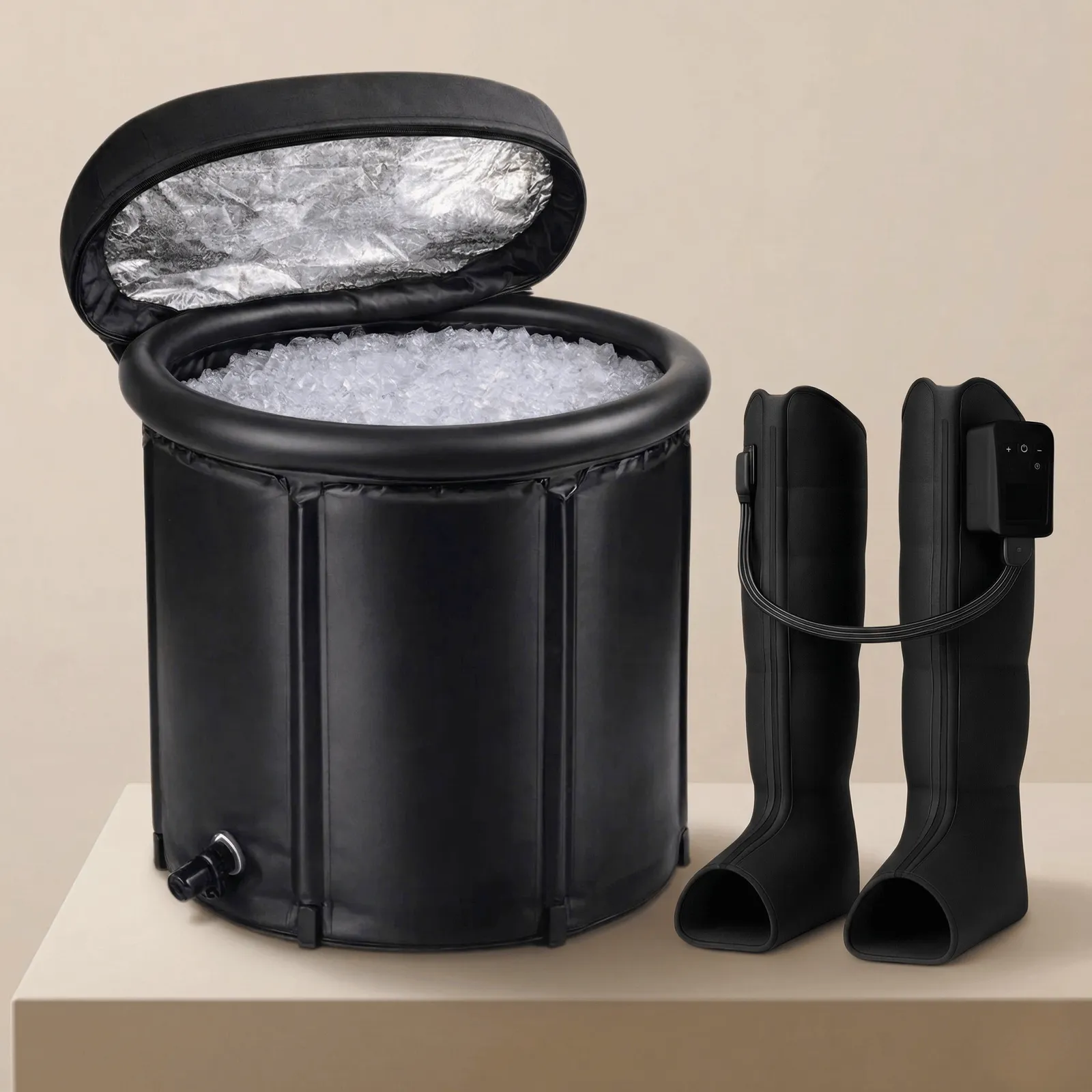
| Ice bath | best researched | effort to set up, affects the whole body |
| Thermo Flex | heat, cold and contrast with set levels, hands-free | local only, not for fresh injuries |
Common mistakes with heat and cold
- Ice straight on the skin: always use a cloth in between. Cold injuries happen faster than most people think.
- Heat on a fresh injury: after a rolled ankle, a dead leg or swelling, heat increases blood flow exactly where you do not want it.
- Intense cold right before sprinting: cold muscles react more slowly. If you still have to play or sprint, warm up again properly.
- Icing after every session in a building phase: see the section on muscle growth.
- Falling asleep with it on: this risks burns or cold injury.
And with a fresh injury?
After a strain, a knock or a rolled ankle, many people reach for ice by reflex. Sports physiotherapists Dubois and Esculier question the routine use of anti-inflammatory measures in the first days in their PEACE & LOVE framework (2020), and they name ice as part of that debate. Cold can ease pain in the short term; whether it improves healing is not proven. Rest, elevation and getting checked are more important if swelling is marked or you cannot bear weight. According to the manufacturer, recovery devices such as Thermo Flex are not intended for acute injuries, fresh bruises, sprains or fractures.
Who heat and cold suit, and who should be careful
Suitable for
- athletes with soreness after unfamiliar training
- people with tension from sitting or one-sided strain
- football and rugby players with a busy fixture list
- runners and cyclists after long or hard sessions
Not suitable, or only after medical advice
- broken, irritated or inflamed skin
- circulation disorders, thrombosis or increased thrombosis risk
- cold intolerance such as Raynaud's (for cold)
- reduced sensation of heat, cold or pain, for example with diabetes
- acute inflammation, fever, pregnancy, pacemaker
If symptoms do not improve after a few days, or you have pain without an obvious training cause, please get it checked by a doctor. More articles on the science of recovery are in our recovery knowledge section.
Conclusion
Heat is the better choice for tension, stiffness and soreness from the day after, while cold fits the first hour after hard exercise and quick turnarounds between matches. Athletes with busy training and match schedules and people with everyday muscle tension benefit most. The evidence is limited, regular intense cold can blunt muscle growth, and neither method replaces a proper assessment of a fresh injury.
Frequently asked questions
Is heat or ice better for sore muscles?
Should I use heat or ice for a tight neck or back?
How long should I apply heat or ice?
Does icing after training reduce muscle growth?
Should I ice a pulled muscle or a bruise?
When should I avoid heat and cold altogether?
Heat or cold before training?
Sources
- Wang, Y. et al. (2021). Heat and cold therapy reduce pain in patients with delayed onset muscle soreness: A systematic review and meta-analysis of 32 randomized controlled trials. Physical Therapy in Sport, 48, 177–187.
- Malanga, G. A., Yan, N., Stark, J. (2015). Mechanisms and efficacy of heat and cold therapies for musculoskeletal injury. Postgraduate Medicine, 127(1), 57–65.
- Petrofsky, J. et al. (2017). The Efficacy of Sustained Heat Treatment on Delayed-Onset Muscle Soreness. Clinical Journal of Sport Medicine, 27(4), 329–337.
- Roberts, L. A. et al. (2015). Post-exercise cold water immersion attenuates acute anabolic signalling and long-term adaptations in muscle to strength training. Journal of Physiology, 593(18), 4285–4301.
- Machado, A. F. et al. (2016). Can Water Temperature and Immersion Time Influence the Effect of Cold Water Immersion on Muscle Soreness? Sports Medicine, 46(4), 503–514.
- French, S. D. et al. (2006). Superficial heat or cold for low back pain. Cochrane Database of Systematic Reviews, CD004750.
- Dubois, B., Esculier, J.-F. (2020). Soft-tissue injuries simply need PEACE and LOVE. British Journal of Sports Medicine, 54(2), 72–73.