Vibration massage: benefits, how it differs from percussion, how to use it
The main vibration massager benefits are less soreness in the days after hard training and a short-term gain in mobility, delivered more gently than a massage gun. That is the honest summary. The marketing around these devices goes much further, from fat loss to detox, and none of it holds up. In this guide I separate the two: what local vibration does inside a muscle, what ten controlled trials on delayed-onset muscle soreness measured, how vibration differs from percussion, and how to use a vibration massager properly.

You will also know exactly where vibration does not belong.
This is our core article on vibration massage. It sits in our knowledge section on recovery, and if you want to see how vibration fits alongside sleep, compression and heat, read our complete guide to muscle recovery. Already set on buying a device and just torn between precise and powerful? Go straight to trigger point massager vs massage gun.
In this article you will learn:
- what a vibration massager physically does
- what studies found on soreness, mobility and strength
- how vibration differs from the percussion of a massage gun
- how to use one step by step
- where vibration is off limits and when heat or cold is the better choice
01. What is vibration massage?
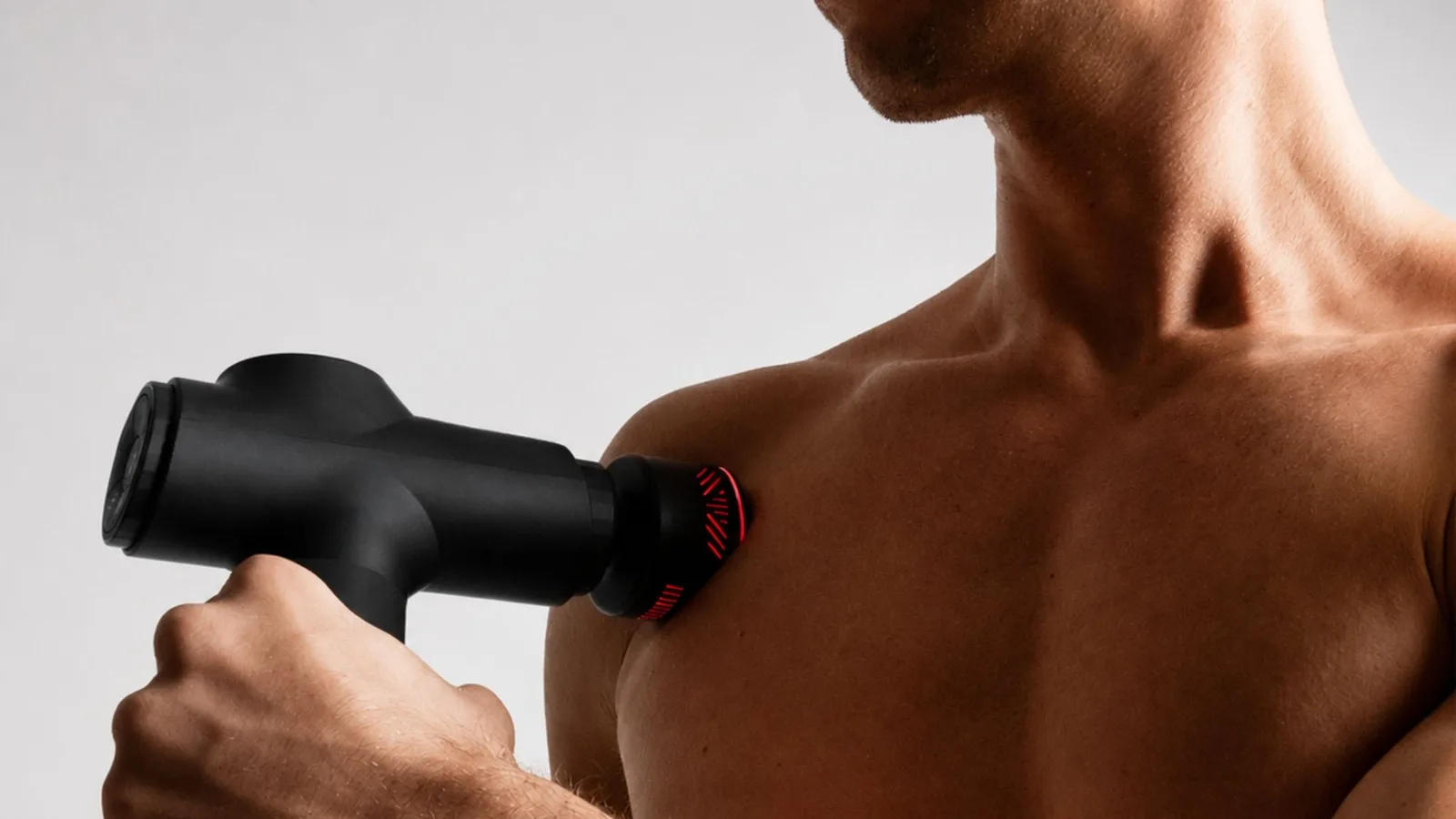
A vibration massager transmits small, rapid oscillations into the skin and muscle. The contact point stays on the skin and shakes back and forth. Researchers call this local muscle vibration to separate it from vibration plates you stand on with your whole body. Whole-body vibration is a different topic and not what this article covers.
Two numbers describe any vibration: frequency, how many times per second it oscillates (hertz), and amplitude, how far it moves each time (millimetres). A 2018 review (Germann et al.) shows how wide the range is. Across the 21 studies it assessed, frequencies ran from 5 to 300 Hz, amplitudes from 0.12 to 12 mm and session length from 6 seconds to 30 minutes. So there is no single "vibration massage", just a lot of variations.
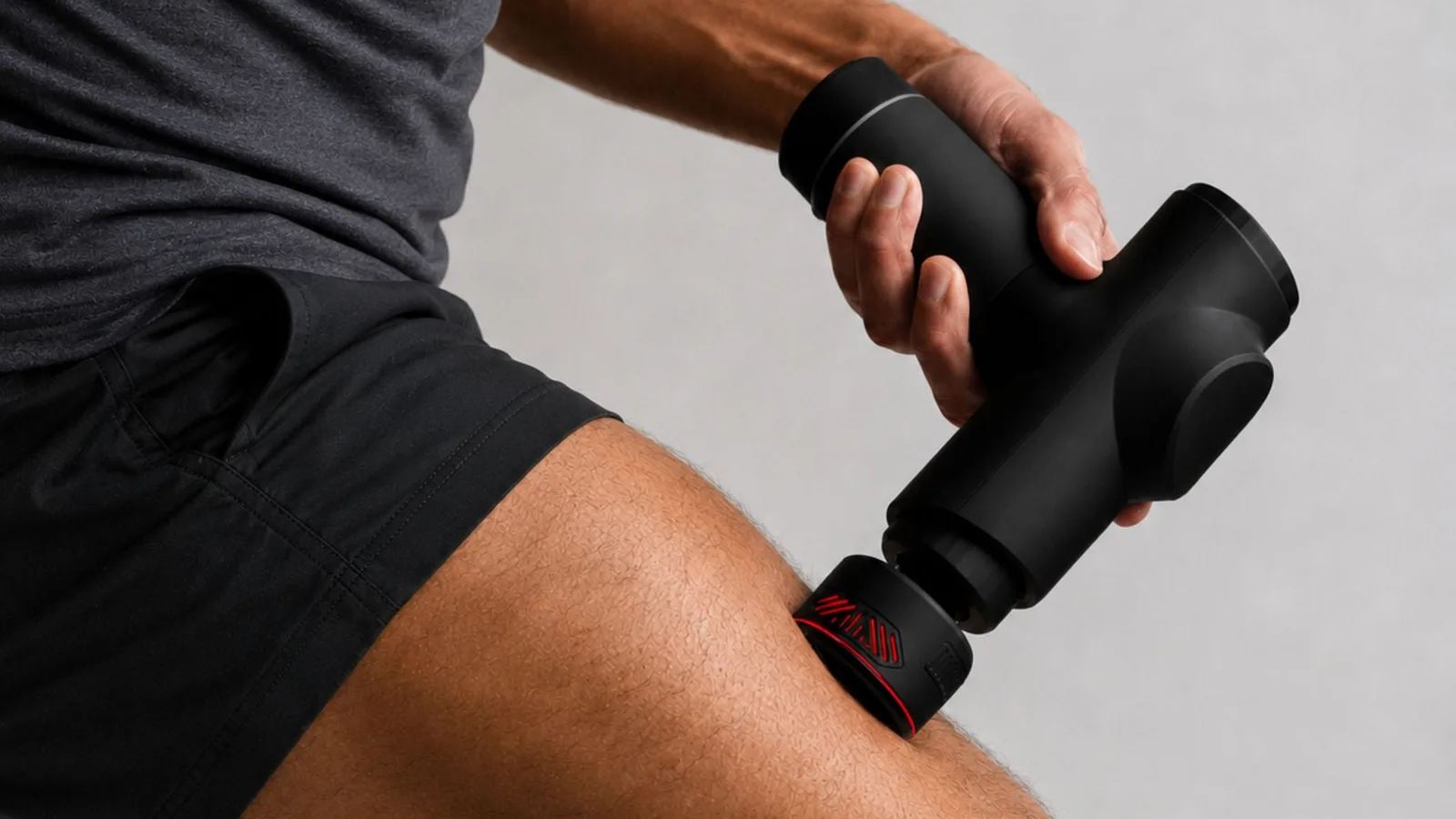
Handheld devices also differ in how they make contact. Broad vibration spreads the oscillation over a larger surface, such as the whole calf. Point vibration focuses it through a small tip or nub onto one spot, say a tight point in the upper trapezius after a long drive. The Vibra Grip does both and uses a fine nub for the point work.
02. How does vibration affect the muscle?
Skin, muscle and tendon are full of receptors that respond to pressure, stretch and vibration. A vibration massager fires these receptors in very quick succession. Your nervous system processes that flood of signals, and you notice two things in practice.
First, pain often feels duller for a while. You already know the principle from rubbing a knock on your shin: a strong touch signal drowns out the pain signal. Second, the muscle tends to feel looser and range of motion goes up for a short time. Germann et al. found positive effects on muscle activation, strength, power or flexibility in most of the 21 studies. They also stress that the protocols were so different that no clear recommendation follows from them. Study quality averaged just under 6 out of 10 on the PEDro scale, which is middling.
What vibration does not do appears in no serious study: it does not burn fat, flush toxins or replace training. If a device promises that, it is marketing.
Worth knowing
Most studies test a single session and measure minutes to a few days afterwards. What regular vibration massage does over months has barely been studied.
03. Does vibration massage help with sore muscles? The evidence
This is where most of the data sits. A controlled study from 2014 (Imtiyaz et al.) split 45 untrained women into three groups before an unfamiliar eccentric workout. One group got 5 minutes of vibration at 50 Hz, one got 15 minutes of classic massage, and one got nothing. Both treated groups reported clearly less soreness at 24, 48 and 72 hours than the control group, and vibration and massage performed similarly for pain. Maximal strength did not differ between the groups.
A 2019 meta-analysis (Lu et al.) pooled 10 controlled trials with 258 participants. Vibration lowered pain scores at 24, 48 and 72 hours after exercise. Creatine kinase, a blood marker of muscle stress, was lower at 24 and 48 hours, but no longer at 72 hours.
Now the context. A large 2025 umbrella review (Wiecha et al.) looked at 29 systematic reviews covering 863 trials of physical treatments for soreness. Seventeen of those reviews were of critically low quality. Vibration only showed up with an effect at 72 hours and in the weakest evidence class; compression, contrast therapy and massage did somewhat better. That does not mean vibration is useless. It means you can expect noticeable relief, not a switch that turns soreness off.
| Finding | What was measured | How solid |
|---|---|---|
| Less soreness | Pain scores 24–72 h after exercise (Lu et al. 2019, 10 trials) | moderate, many small trials |
| More mobility | Range of motion straight after use (Germann et al. 2018) | moderate, protocols vary widely |
| No strength loss | Maximal strength after vibration vs control (Imtiyaz et al. 2014) | one small study |
| Long-term benefit | hardly any studies over weeks or months | unknown |
04. Vibration or percussion: what is the difference?
Both devices move fast, but in completely different ways. A vibration massager shakes with a small amplitude on the skin. A massage gun pushes its head into the tissue with every stroke and pulls it back, which is called percussion. It feels like very fast tapping, goes deeper and is noticeably more intense. How to use a gun properly is covered in our guide how to use a massage gun.
| Vibration massage | Percussion (massage gun) | |
|---|---|---|
| Movement | fast oscillation, contact stays on the skin | strokes, head drives into the tissue |
| Feel | gentle, humming | strong, tapping |
| Best at | single spots, smaller muscles, sensitive days | big muscle groups such as quads and glutes |
| Research focus | mainly soreness and mobility | mainly mobility, soreness results mixed |
| Noise and weight | usually quieter and lighter | usually louder and heavier |
Massage guns now have their own data. In a 2020 study (Konrad et al.), 5 minutes of percussion on the calf increased ankle range of motion while strength stayed the same. Both methods aim at similar effects at different intensities. Which suits you depends less on the science than on which muscles you want to treat and how much pressure you like. I compare the two in detail in Vibra Grip or massage gun.

05. How do you use a vibration massager properly?
In short: lowest setting, muscle only, move slowly, 1–2 minutes per area. Here is the detail.
- Pick the spot. Muscle tissue only: calves, thighs, glutes, the muscles either side of the spine, chest, forearms, shoulders. Leave joints, bones, the spine itself, neck and head out of the vibration.
- Start on the lowest setting. The Vibra Grip has 10 levels. Only go up once it feels comfortable and you want more.
- Broad or point? For a whole muscle, use broad vibration and glide slowly along the fibres. For one tight spot, set the nub on it and hold still for 20–30 seconds.
- No pressing. Let the device rest on the muscle. Pushing harder does not make it more effective, just less pleasant.
- Move on after 1–2 minutes. That is also what the Vibra Grip product page recommends. A full round usually takes 5–10 minutes.
- Breathe and relax. Sit or lie so the muscle is slack. A tense muscle barely lets the vibration in.

Before or after training?
Before training, keep it short as part of your prep: 30–60 seconds per muscle, then your usual warm-up. After training or in the evening, 1–2 minutes per area is fine. Interestingly, in the Imtiyaz study the vibration was applied before the workout and still reduced soreness over the following days. After a Saturday football match or a long run, I would use it on calves and hamstrings in the evening and leave the quads to a massage gun.
"In contest prep my forearms get so tight after pull days that any percussion feels harsh. Point vibration on a low setting is my tool there: two minutes per side, and my grip feels freer the next morning."
06. Vibration, heat or cold: which and when?
Many vibration devices, the Vibra Grip included, combine vibration with heat and cooling. That is handy because each function follows different rules.
- Vibration: muscle only. For single tight spots and loosening up after training.
- Heat: the Vibra Grip offers infrared heat at three levels (40, 45 and 50 °C). Heat suits stiff muscles and the time before exercise. You may use the heat function on the neck and on joints too.
- Cold: three cooling levels (15, 10 and 5 °C) for a calming feel after hard efforts. Cooling is also fine on the neck and joints.
So a stiff neck after a day at the laptop calls for heat, not vibration. When heat beats cold and the other way round is explained in heat or ice for sore muscles. If your evenings are spent gaming at a screen, have a look at our sleep and neck routine for gamers.

07. Where should you never use vibration?
Always leave these areas out when the vibration is on:
- joints and bones: knees, elbows, shinbone, heel, wrist
- the spine itself
- neck, throat and head
- fresh injuries, strains, bruises, sprains and fractures
- broken, irritated or inflamed skin
- areas with thrombosis or severe varicose veins
Skip it altogether when you have an acute inflammation, a fever or an infection. The logic is simple: vibration is made for muscle tissue. Bones and joints have little padding, so the oscillation hits sensitive structures directly.
Check with your GP first
If you take blood thinners or bruise easily, are pregnant, have a pacemaker or another implant, osteoporosis, recent surgery or a joint replacement, speak to your doctor before using a vibration massager. The same applies if you feel heat or pain less well, for example with diabetic nerve damage. If symptoms do not settle, get them checked.
08. Who is vibration massage for, and who not?
A good fit for anyone who finds a massage gun too harsh, for smaller muscles such as forearms, calves and the soles of the feet, and for single tight spots in the shoulder or glutes. Climbers, padel and tennis players, lifters after pull days and runners with tight calves get the most from it. Padel players will find a dedicated forearm and shoulder recovery routine for padel. How to find those spots is explained in finding trigger points and knots.
Less suited to big muscle groups after heavy leg sessions. A massage gun is more efficient on quads and glutes, and compression boots cover both legs more evenly after a match or a long run. It is also no substitute for a diagnosis: pain that has not improved after a week belongs with your GP or a physiotherapist.

Vibra Grip trigger point massager
Broad and point vibration on 10 levels, infrared heat and cooling on 3 levels each, cordless and 600 g.
09. What to look for in a vibration massager
If you are shopping, these five points help more than any headline figure:
- Levels: several settings let you start gently. The Vibra Grip has 10.
- Contact surface: broad for whole muscles, a small nub for single spots.
- Heat and cold: extends use to the neck and joints, where vibration is off limits.
- Weight and battery: a light, cordless device actually ends up in your kit bag.
- Safety information: a reputable maker says clearly where the device does not belong.
Conclusion
A vibration massager loosens muscles with small, rapid oscillations and, according to the research, can ease soreness in the days after training and improve mobility for a short while. It suits athletes who find a massage gun too strong or who want to work on single spots and smaller muscles. Most of the studies are small and inconsistent, and vibration belongs on muscle only, never on joints, the spine or the neck.
Frequently asked questions
What are the benefits of a vibration massager?
Does vibration massage help with DOMS?
Is a vibration massager the same as a massage gun?
How long should I use a vibration massager?
Can I use a vibration massager on my neck?
How often can I use vibration massage?
Who should not use a vibration massager?
Sources
- Lu, X. et al. (2019). Does vibration benefit delayed-onset muscle soreness?: a meta-analysis and systematic review. Journal of International Medical Research, 47(1), 3–18. – Meta-analysis of 10 trials, 258 participants
- Imtiyaz, S., Veqar, Z. & Shareef, M. Y. (2014). To Compare the Effect of Vibration Therapy and Massage in Prevention of Delayed Onset Muscle Soreness (DOMS). Journal of Clinical and Diagnostic Research, 8(1), 133–136.
- Germann, D. et al. (2018). Effects of local vibration therapy on various performance parameters: a narrative literature review. Journal of the Canadian Chiropractic Association, 62(3), 170–181. – Review of 21 studies on local muscle vibration
- Wiecha, S. et al. (2025). Physical Therapies for Delayed-Onset Muscle Soreness: An Umbrella and Mapping Systematic Review with Meta-meta-analysis. Sports Medicine, 55(5), 1183–1212. – 29 reviews, 863 trials
- Konrad, A. et al. (2020). The Acute Effects of a Percussive Massage Treatment with a Hypervolt Device on Plantar Flexor Muscles' Range of Motion and Performance. Journal of Sports Science and Medicine, 19(4), 690–694.
- Ractiveone: Vibra Grip specifications and safety notes (10 vibration levels, infrared 40/45/50 °C, cooling 15/10/5 °C), as of 15 Oct 2026.