Vibra Grip or massage gun? Precise point work vs broad percussion
A trigger point massager like the Vibra Grip works precisely with vibration; a massage gun like the Revive Pulse Pro works broadly and powerfully with percussion. Both promise looser muscles and both now come with heat and cooling, which makes the choice harder than it looks.

In this comparison I put the two side by side: how they work, what the research says about vibration and percussion, which device belongs on which body area and which type of athlete gets more from each. At the end you get three questions that settle the decision in a minute.
This comparison builds on our core article vibration massage benefits and how to use it, which explains what vibration does inside a muscle and what the studies show. Here the question is practical: Vibra Grip or massage gun, and for what exactly? More how-tos are in our recovery guides.
01. The short answer
If you want to work on single tight spots, smaller muscles or sensitive areas, choose a precise trigger point massager such as the Vibra Grip. If you want to loosen big muscle groups after heavy sessions, choose a massage gun such as the Revive Pulse Pro. If you need both regularly, combine them: the gun for quads and glutes, the Vibra Grip for forearms, calves and single spots.
02. How do vibration and percussion differ?
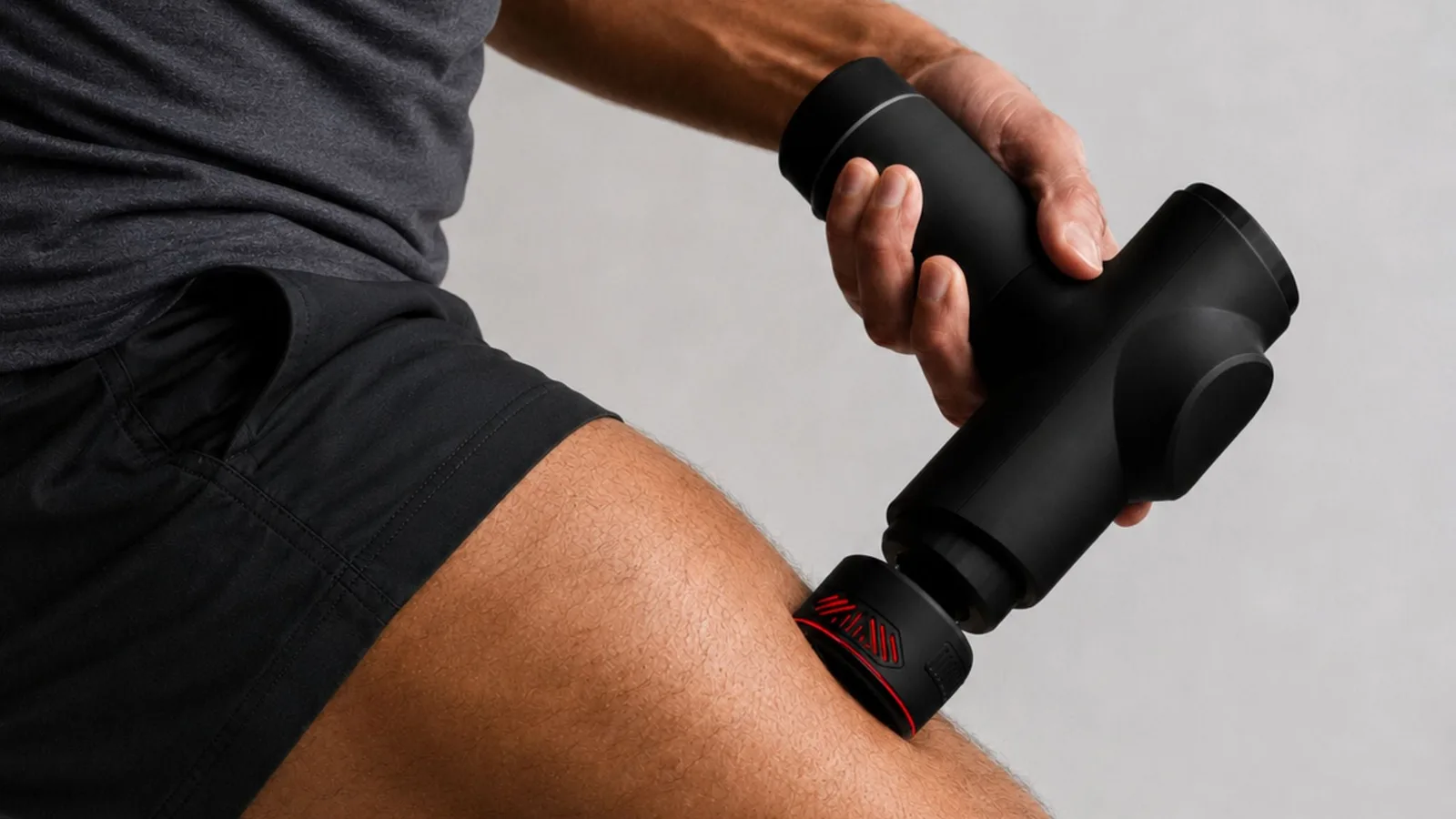
The Vibra Grip makes its contact point oscillate quickly with a small amplitude on the skin. Its fine nub focuses that vibration on one spot; without the nub it spreads it over a wider area. The Revive Pulse Pro drives its head into the tissue with every stroke and pulls it back. That is percussion: deeper, stronger and louder.
There is data on both methods, but no large trials. A 2019 meta-analysis (Lu et al.) found less soreness 24 to 72 hours after exercise with vibration. For massage guns, a 2020 study (Konrad et al.) showed more ankle mobility after 5 minutes on the calf with no loss of strength. A 2023 review of 11 studies (Ferreira et al.) confirms that short-term gain in mobility but found no benefit for jumping or sprinting. Nobody has compared the two device types head to head yet.
03. Vibra Grip vs Revive Pulse Pro
| Vibra Grip | Revive Pulse Pro | |
|---|---|---|
| Method | vibration, broad or focused | percussion (strokes) |
| Levels | 10 vibration levels | 5 speeds (1,800–3,000 percussions/min) |
| Contact | fine nub for single spots | 5 attachments incl. ball, bullet and fork head |
| Heat | infrared on 3 levels: 40, 45, 50 °C | via the heat/cool attachment |
| Cold | 3 levels: 15, 10, 5 °C | via the heat/cool attachment |
| Weight | 600 g | approx. 776 g |
| Battery | 2200 mAh, USB-C charge in about 3 hours | 2400 mAh, 3–4 hours run time, USB-C |
| Strength | precise, gentle, smaller muscles | powerful, big muscle groups |
On the search for a "massage gun with heat": most people mean a device that combines massage and warmth. The Pulse Pro does it with a head that heats and cools. Infrared heat with fixed temperature levels comes with the Vibra Grip, though with vibration instead of percussion.
04. Which device for which body area?
One rule applies to both: muscle only. With the Vibra Grip, add one more: the vibration never goes on the neck, spine or joints. Heat and cooling may.
| Body area | Better choice | Why |
|---|---|---|
| Quads, hamstrings, glutes | Pulse Pro | lots of muscle mass, handles percussion well |
| Back muscles beside the spine | Pulse Pro with fork head | the vertebrae sit between the prongs |
| Calves | both | gun for the whole muscle, Vibra Grip for single tight points |
| Forearms, soles of the feet | Vibra Grip | small muscles, percussion often too harsh |
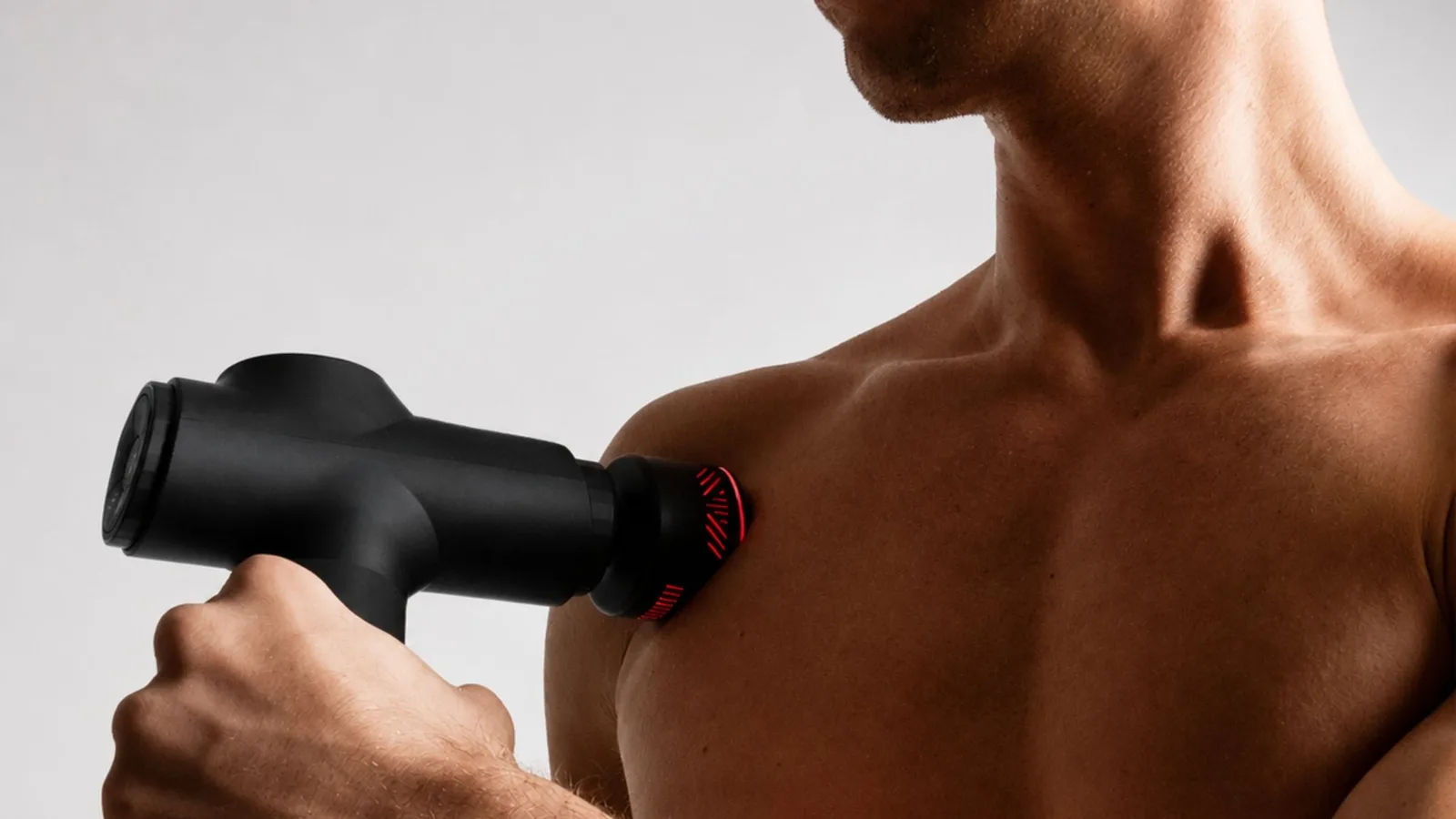
| Shoulder, chest | Vibra Grip, point mode | targets single spots, keeps clear of bone |
| Neck | Vibra Grip with heat or cold only | vibration off limits; the gun only on the upper trapezius at speed 1 |
I have written a separate guide for the back: using a massage gun on your back. How long to use the gun per muscle and which attachment does what is covered in how to use a massage gun properly.

05. What does a trigger point massager do for tight spots?
Almost everyone knows those hard, tender points in a muscle. Whether they are distinct "trigger points" is disputed, though. A critical 2015 review (Quintner et al.) questions whether they exist as a separate structure, without denying the symptoms people feel. For you that means no device "dissolves" a knot. It can, however, loosen a tense area and ease the tender feeling for a while.
My routine: find the spot with your finger, set the nub on it, lowest level, hold for 20–30 seconds, then treat the whole muscle broadly for 1–2 minutes. With the gun, use the bullet head on the same point for only 10–20 seconds. How to find tight spots on your body is shown in finding trigger points and knots.
"After heavy leg days I reach for the gun; for my forearms after pull days and my calves after cardio, the Vibra Grip. I stopped trying to use one device for everything."
Both devices in one training week
If you own both, do not double up on the same muscle. This is how I split them across four lifting days:
- Leg day: Pulse Pro on quads and glutes in the evening, 1–2 minutes per muscle, and only gently after very heavy squats.
- Pull day: Vibra Grip in point mode on the forearms and between shoulder and shoulder blade, 1–2 minutes each.
- Push day: Vibra Grip on chest and front of the shoulder, keeping clear of the collarbone and breastbone.
- Rest day: Pulse Pro on calves and back, Vibra Grip with heat on the neck after a day at the desk.
That keeps you at 5–10 minutes a day. More rarely adds anything, and a muscle that feels irritated the next day gets a day off.
06. Heat and cold: where is the difference?
Both devices heat and cool, but differently. On the Vibra Grip you pick the temperature in fixed levels and can use heat or cold without the vibration. That makes it the device for areas where vibration does not belong, such as a stiff neck after a day at the desk. On the Pulse Pro, heat and cooling sit in the attachment and come combined with percussion. When to use heat and when cold is explained in heat or ice for sore muscles.
07. Which device suits whom, and who should skip it?
The Vibra Grip suits climbers, padel and tennis players, lifters with tight forearms and anyone who finds a massage gun too harsh. What that looks like after a match is laid out in our padel recovery for forearm and shoulder. It is also the better pick for desk workers and gamers who want heat for a stiff neck. For long evenings at the screen there is a dedicated sleep and neck routine for gamers.
The Revive Pulse Pro suits lifters, runners, footballers, rugby players and Hyrox athletes who want to loosen quads, glutes and back after heavy sessions.
For both: not on fresh injuries, bruises, inflammation, varicose veins or thrombosis. If you take blood thinners, are pregnant or have a pacemaker, osteoporosis or nerve damage, check with your GP first. Pain that has not improved after a week belongs with a doctor or physiotherapist, not under a massager.

Vibra Grip trigger point massager
Vibration on 10 levels, fine nub, infrared heat and cooling on 3 levels each.

Revive Pulse Pro massage gun
5 speeds, 5 attachments including a heat/cool head, 3–4 hours of battery.
08. Three questions to decide
- Which muscles do you treat most? Big muscle groups point to the gun; smaller muscles and single spots to the Vibra Grip.
- How much pressure do you like? If percussion quickly feels unpleasant, vibration is the better choice.
- Do you want heat or cold on the neck or joints? Then the Vibra Grip wins, because you can use heat and cold there without vibration.
Conclusion
The Vibra Grip is the better device for precise, gentle work on smaller muscles and single tight spots; the Revive Pulse Pro is better for powerful treatment of big muscle groups. If your week is built around heavy leg days, start with the gun; if you mostly want to loosen forearms, calves and shoulders or use heat on your neck, start with the Vibra Grip. Studies on both methods are small, a direct comparison is missing, and neither device replaces a diagnosis.
Frequently asked questions
Is a trigger point massager better than a massage gun?
Is there a massage gun with heat?
Can I use the Vibra Grip on my neck?
Do I need both devices?
Do massagers really release trigger points?
Which one is quieter and lighter?
Sources
- Lu, X. et al. (2019). Does vibration benefit delayed-onset muscle soreness?: a meta-analysis and systematic review. Journal of International Medical Research, 47(1), 3–18.
- Konrad, A. et al. (2020). The Acute Effects of a Percussive Massage Treatment with a Hypervolt Device on Plantar Flexor Muscles' Range of Motion and Performance. Journal of Sports Science and Medicine, 19(4), 690–694.
- Ferreira, R. M. et al. (2023). The Effects of Massage Guns on Performance and Recovery: A Systematic Review. Journal of Functional Morphology and Kinesiology, 8(3), 138.
- Quintner, J. L., Bove, G. M. & Cohen, M. L. (2015). A critical evaluation of the trigger point phenomenon. Rheumatology, 54(3), 392–399. – Critical review of the trigger point model
- Ractiveone: Vibra Grip specifications (10 vibration levels, infrared 40/45/50 °C, cooling 15/10/5 °C, 600 g), as of 15 Oct 2026.
- Ractiveone: Revive Pulse Pro specifications (5 speeds, 5 attachments incl. heat/cool head, approx. 776 g), as of 15 Oct 2026.