Massage gun attachments explained: which head for what?
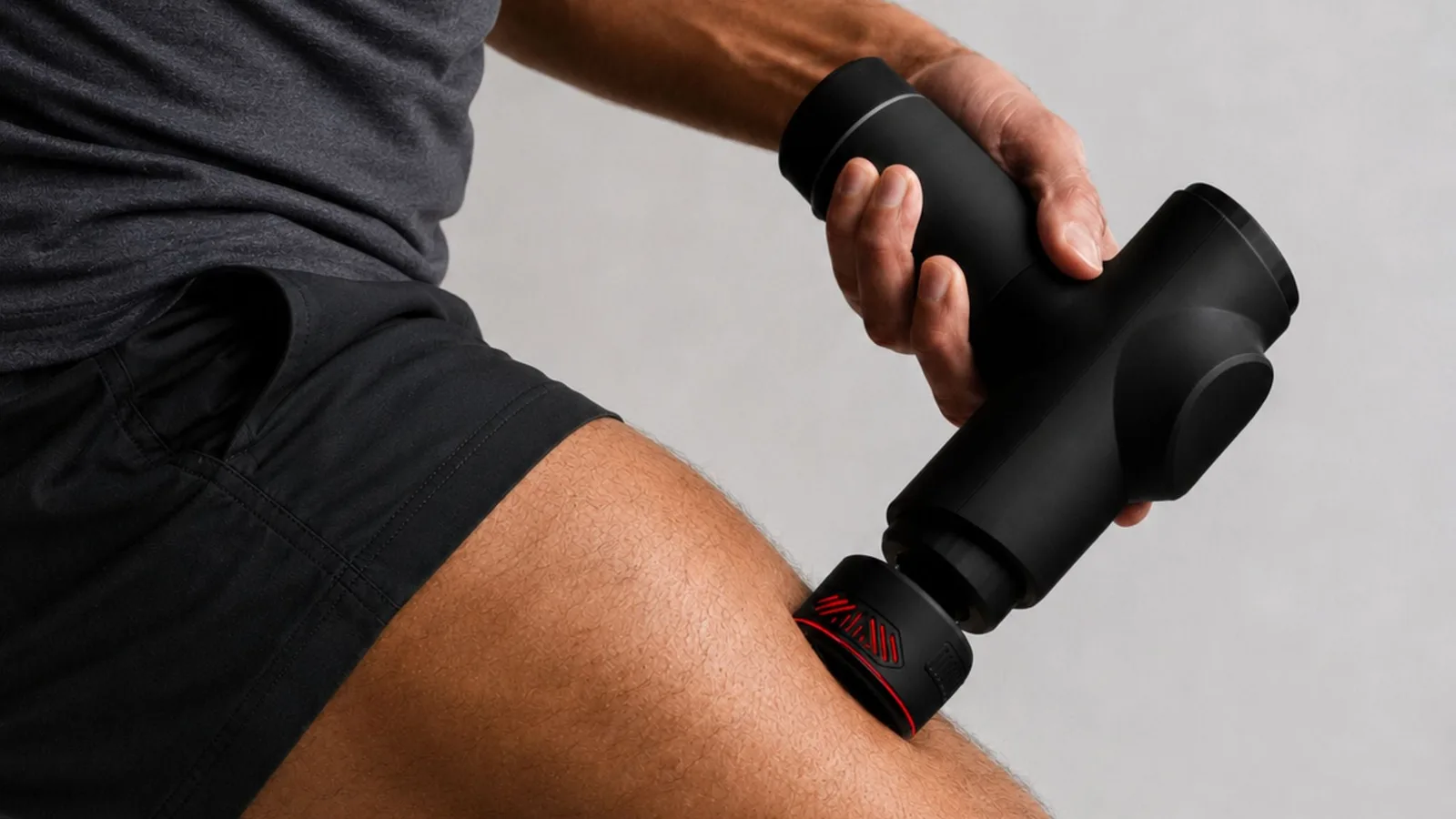
Massage gun attachments look like extras, but they decide where the force lands. The same motor feels gentle through the flat head and quickly too harsh through the bullet. Most guns ship with four to six heads, and the leaflet rarely tells you when to use which. Here I go through the five heads of the Revive Pulse Pro one by one: shape, best use, speed and timing.

You also get a table by body area, an honest look at the research and the bullet-head mistakes I see most often with the athletes I coach.
This article builds on our guide on how to use a massage gun, which covers timing and pressure. Here the focus is the heads alone: what each one is for and why the wrong attachment turns a good session into an unpleasant one. I use a massage gun after almost every leg session and switch heads two or three times along the way.
01. Why do massage guns come with different heads?
Because the contact area decides how hard each hit lands per square centimetre. The motor delivers the same force every time. Spread over the flat head, it feels gentle. Focused through the bullet, the same speed can already be too much. Shape matters as well: a fork can work two strips of muscle at once and leave a structure in the middle alone, while a ball follows the curve of a rounded muscle.
So the head is not a detail. Next to the speed setting, it is your second intensity dial.
02. The 5 heads at a glance
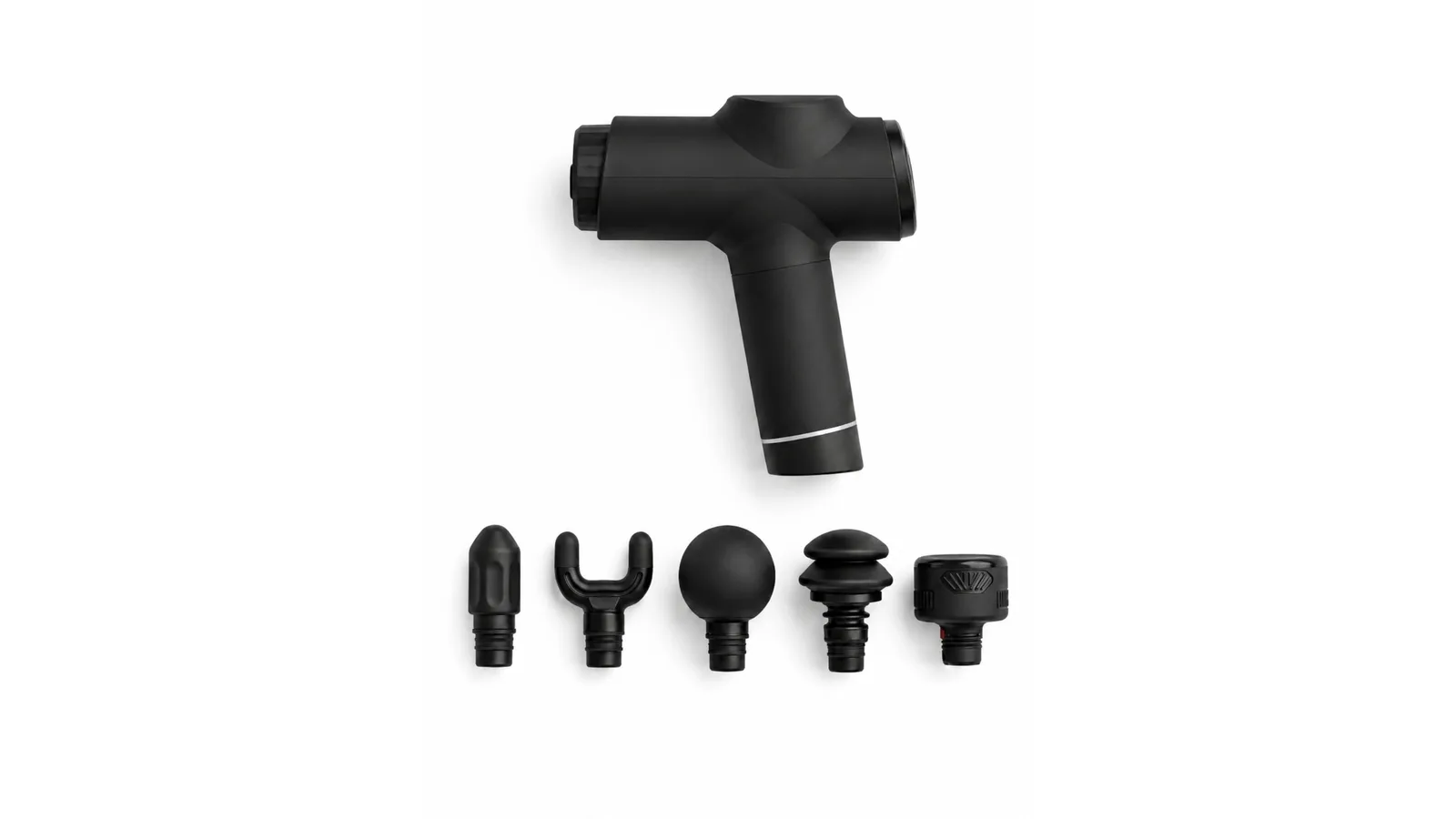
The Revive Pulse Pro comes with four standard heads plus a heated/cooling head. You will find these five shapes, or close relatives, on most massage guns.
| Head | Contact area | Best for | Speed | Time per area |
|---|---|---|---|---|
| Ball | medium, round | quads, hamstrings, glutes, arms, calves | 1–3 | 60–120 seconds |
| Flat | large, even | sensitive areas, chest, after hard sessions | 1–2 | 60–120 seconds |
| Bullet | very small | single tight spots in large muscles | 1–2 | 10–20 seconds per point |
| Fork | two prongs | muscles beside the spine, upper trapezius, calves | 1–2 | 30–90 seconds |
| Heated/cooling | medium, temperature-controlled | warmth before, cooling after exercise | 1–2 | 1–2 minutes |
03. Ball head: the all-rounder
If you only ever use one head, make it this one. The round shape follows quads, glutes, upper arms and calves, and it forgives small errors in angle. It is also the head researchers tend to use. In a 2023 study (Skinner et al.), 20 participants had their hamstrings treated with the standard ball attachment for two bouts of 60 seconds. Range of motion in a passive straight leg raise rose by just over 11 per cent and tissue stiffness fell by 6 per cent.
How I use it: after squats and leg press, on quads and glutes, speed 2, 60 to 90 seconds per side.
04. Flat head: gentle and broad
The flat head has the largest contact area, which makes it the gentlest option. It suits areas where the muscle is thinner or more sensitive: chest, the muscle beside the shin, forearms, the inner thigh with light pressure. It is also the head for days when your legs are already tender after a hard match or a long run. If you are new to percussion and find the ball too strong, start here.
05. Bullet head: for single spots only
Almost everyone overrates the bullet. It concentrates all the force onto a fingertip-sized area and is meant for individual tight spots, for example in the glutes or calves. Use it only where there is plenty of muscle and stay on the point for 10 to 20 seconds, then switch back to the ball. Never on bone, tendons, the spine, the groin or the back of the knee. How to find those knots in the first place is covered in releasing trigger points with a massage gun.
"The mistake I see most: bullet head on, top speed, a full minute on the same spot. The muscle ends up irritated, not looser. I use the bullet for two or three spots per session at most, and on the lowest speed."
06. Fork head: spine, neck and calves
The fork has two prongs with a gap in between. That lets you treat the two strips of muscle either side of the spine at once while the vertebrae sit in the gap. The same idea works on the upper trapezius and on the calves. To be clear: the fork does not make the spine a safe zone. The prongs rest on muscle, left and right, never on a vertebra. The full back routine is in our massage gun guide for the back.
On the neck you only work where it meets the shoulder, on the lowest speed, 30 to 60 seconds per side. Areas that no head should touch are listed in where not to use a massage gun.
07. What does the heated/cooling head do?
The fifth head on the Revive Pulse Pro can be heated or cooled, adding temperature to the percussion. The idea is warmth before training so stiff muscles feel more supple, and cooling afterwards to settle worked muscles. Heat raises blood flow and tissue extensibility, while cold lowers tissue temperature and dulls pain signals, as a 2015 review (Malanga et al.) sums up.
To be honest, no study has compared a heated head directly with a standard one. It is a comfort gain, not a proven performance edge. Fresh injuries with swelling should not be warmed. And if you cool hard after every strength session, know that regular cold can blunt training adaptations. Our explainer on heat or ice for sore muscles covers when each makes sense.
08. Which head for which body area?
| Body area | First choice | Alternative | Take care |
|---|---|---|---|
| Quads and hamstrings | Ball | flat, heated | keep clear of knee and groin |
| Glutes | Ball | bullet for single spots | not on the tailbone |
| Calves | Fork or ball | flat after long runs | skip the Achilles and back of the knee |
| Upper back | Fork | ball between the shoulder blades | never on the vertebrae |
| Neck and shoulder | Fork or flat, speed 1 | heated | front and sides of the neck off limits |
| Chest | Flat | ball with light pressure | keep clear of breastbone and armpit |
| Forearms | Flat, speed 1 | ball | not on the elbow |
| Sole of the foot | Flat, speed 1 | ball | not on the heel |
Runners and footballers will find a calf routine with timings in tight calves after running.
09. What does a routine with head changes look like?
This is my routine after a heavy leg day, about 8 minutes in total:
- Ball, speed 2: quads and hamstrings, 60 to 90 seconds per leg each.
- Ball, speed 2: glutes, 60 seconds per side.
- Bullet, speed 1: two tight spots in the glutes, 15 seconds each.
- Fork, speed 1: calves from heel towards the back of the knee without touching either, 60 seconds per side.
Before training one head is enough: the ball or the heated head, 30 to 60 seconds per muscle, then your normal warm-up.
10. What does the research say about attachments?
Very little directly, and you should know that. Massage gun studies almost never compare heads. They usually test one standard head on one large muscle. In a 2020 study (Konrad et al.), five minutes on the calves increased ankle range of motion by 5.4 degrees with no loss of strength. Two 2023 reviews (Ferreira et al. with 11 studies, Sams et al. with 13) confirm short-term gains in flexibility but no benefit for jumping or sprinting, and all included studies had methodological weaknesses.
What I tell you about the individual heads is therefore based on mechanics and training practice, not head-to-head trials.

Revive Pulse Pro massage gun
4 standard heads plus a heated and cooling head, 3 speeds, brushless motor and 3–4 hours of battery life.
11. Who needs several heads, and who does not?
Several heads pay off if you treat different areas: lifters working legs, back and chest, runners with calves and feet, footballers and rugby players with quads and glutes. The flat head and the fork in particular make sensitive areas comfortable.
The choice matters less if you only use the gun on one area, say your quads after cycling. In practice the ball head will do. And no head replaces a diagnosis: pain that has not improved after a week belongs with a GP or physiotherapist.
Conclusion
The ball is the all-rounder, the flat head the gentle one, the bullet the tool for single spots, the fork the head for spine, neck and calves, and the heated/cooling head adds temperature to the percussion. If you treat several areas you will use the full set; if you only loosen one big muscle, the ball is enough. There are no head-to-head studies, so these recommendations rest on mechanics and practice.
Frequently asked questions
Which massage gun attachment is best for beginners?
What is the fork attachment on a massage gun for?
What is the bullet attachment for?
Which massage gun head should I use on my neck?
Is a heated massage gun head worth it?
How often should I switch attachments?
How do I clean massage gun attachments?
Sources
- Skinner, B., Dunn, L., Moss, R. (2023). The Acute Effects of Theragun Percussive Therapy on Viscoelastic Tissue Dynamics and Hamstring Group Range of Motion. Journal of Sports Science and Medicine, 22(3), 496–501. – Used the standard ball attachment
- Konrad, A. et al. (2020). The Acute Effects of a Percussive Massage Treatment with a Hypervolt Device on Plantar Flexor Muscles' Range of Motion and Performance. Journal of Sports Science and Medicine, 19(4), 690–694.
- Ferreira, R. M., Silva, R., Vigário, P. (2023). The Effects of Massage Guns on Performance and Recovery: A Systematic Review. Journal of Functional Morphology and Kinesiology, 8(3), 138.
- Sams, L., Langdown, B. L., Simons, J. (2023). The Effect of Percussive Therapy on Musculoskeletal Performance and Experiences of Pain: A Systematic Literature Review. International Journal of Sports Physical Therapy, 18(2), 309–327.
- Malanga, G. A., Yan, N., Stark, J. (2015). Mechanisms and efficacy of heat and cold therapies for musculoskeletal injury. Postgraduate Medicine, 127(1), 57–65.
- Ractiveone: Revive Pulse Pro, specifications and attachments (4 standard heads plus heated/cooling head, 3 speeds), as of 15 Oct 2026.