Hyrox Recovery: Between Training Blocks and After the Race
Hyrox recovery is harder than recovery for pure runners or pure lifters, because both kinds of load land on the same legs. Eight kilometres of running plus sleds, lunges and wall balls leave your quads, calves and shoulders tired all at once. If you stack running and strength sessions in training, you face the same problem every week.

This article gives you a 7-day plan after race day, a weekly structure for your training blocks and an honest view of what compression boots, a massage gun and heat can do. It draws on the first Hyrox studies and solid data from running and strength training.
Hyrox combines two things that usually get in each other's way in training: running and heavy full-body work. For recovery, that means your legs pay twice. How compression boots can help mechanically is explained in how compression boots support recovery. This article covers the plan after race day and the weeks before it, when you have to fit running and strength blocks together.
Why does Hyrox hit differently from a run?
According to the organiser, the format never changes: eight 1 km runs, each followed by a station. The order is SkiErg, sled push, sled pull, burpee broad jumps, rowing, farmers carry, sandbag lunges and, to finish, wall balls.
The first scientific study (Brandt et al. 2025) put eleven recreational athletes through a simulated race. They took a median of just over 86 minutes, about 51 of them on the runs. Their heart rate sat in hard to very hard zones for almost the entire race. Heart rate, lactate and perceived effort all peaked during the wall balls at the end. Athletes with a higher VO2max and more endurance training were faster.
For recovery, that means your quads and calves are already fatigued by the running and then get extra, partly eccentric work from sleds, lunges and jumps. On top come shoulders and forearms, which barely matter for pure runners.
How common are overuse problems in Hyrox athletes?
A cohort study from the University of Bath (Chittenden et al. 2026) surveyed 89 Hyrox athletes every week for twelve weeks. On average, 30 per cent reported a health problem each week and 18 per cent a substantial one. 73 per cent of injuries were overuse injuries, the knee was the most frequently affected area, and the knee and lower leg carried the greatest burden. The authors link this to the running load.
That is no reason to avoid Hyrox. It does show that load management and recovery are not optional extras in this sport. No device makes up for too much volume.
The 7-day plan after race day
There is no data yet on how long recovery from Hyrox takes. In marathon runners, the muscle damage marker creatine kinase took around six days to return to normal (Bernat-Adell et al. 2021). A Hyrox race is shorter but includes more strength work. So I plan for a week before full training resumes.
| When | Training | Recovery |
|---|---|---|
| Race day | walk for 5–10 minutes after the finish | fluids, carbs and protein, boots for 20–30 min on a low setting in the evening |
| Day 1 | walk or easy cycle | boots 30 min, massage gun on shoulders and forearms |
| Day 2 | mobility, easy swim | boots 20–30 min, heat for soreness |
| Days 3–4 | easy 20–30 min run, light technique at the stations | boots as needed |
| Days 5–7 | first normal sessions, no maximal efforts yet | normal routine |
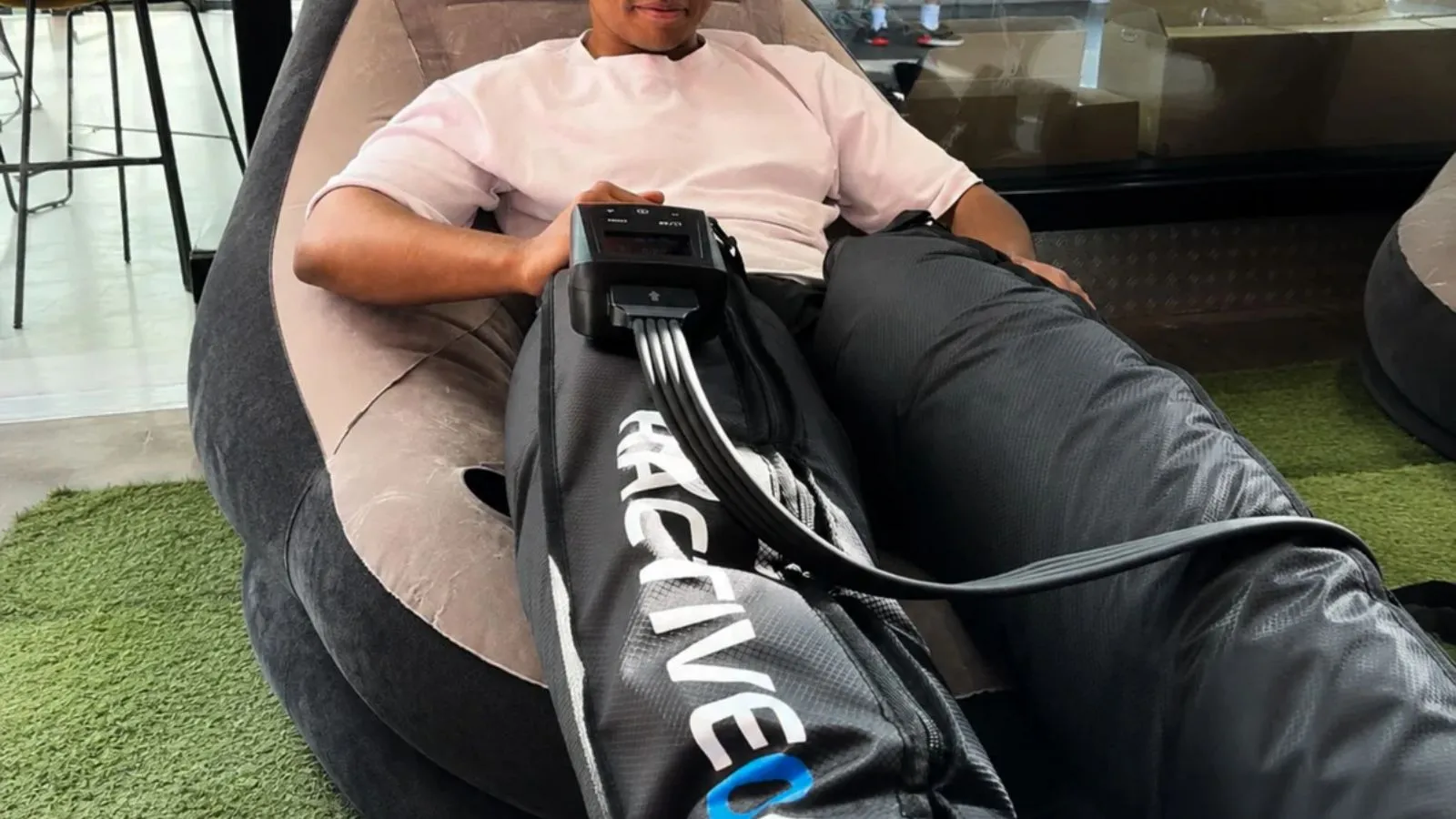
If you want more chambers and finer zone control, the Revive Active Pro recovery boots have 8 chambers. For most Hyrox athletes, the Revive Active compression boots with 7 pressure levels and 5 modes are plenty. How runners use boots after long efforts is covered in compression boots for runners. What the 8 chambers change in practice is set out in Revive Active vs Pro compared.
How do you recover between training blocks?
Hyrox training means stacking running and strength sessions. A meta-analysis on concurrent training (Wilson et al. 2012) shows that endurance work can blunt gains in strength and muscle. How much depended on volume, frequency and type: running interfered more than cycling. I take three rules from that for weekly planning:
- Separate hard runs from heavy leg work. Ideally on different days, otherwise several hours apart.
- Keep one full rest day. Even in race preparation.
- Move easy aerobic work onto the bike. It spares your knees and shins.
| Day | Training | Recovery |
|---|---|---|
| Monday | legs and sled strength | boots 20–30 min in the evening |
| Tuesday | easy run or bike | massage gun on calves 1–2 min |
| Wednesday | running intervals | boots 20 min, early night |
| Thursday | upper body, wall balls, rowing | heat on shoulders or forearms |
| Friday | rest day | walk, no tools needed |
| Saturday | race simulation or long mixed block | boots 30 min in the evening, carb-rich meal |
| Sunday | easy bike or off | boots 20 min if legs feel heavy |
Sleep, protein and carbohydrates still do most of the work. The basics are in our complete muscle recovery guide.
What do boots, a massage gun and heat actually do?
There are no studies on boots in Hyrox, but there are some on similar loads. To be honest, the results are sober:
- Ultra running: after 20 minutes of pneumatic compression, runners felt less fatigued straight away, with no difference in the days after (Hoffman et al. 2016).
- Interval training: over three days of hard intervals followed by compression, soreness, flexibility and 6 km time trial results were no different from a sham treatment; only some markers of muscle breakdown fell (Haun et al. 2017).
- Two efforts on the same day: 30 minutes in boots between two cycling tests did not improve performance, only perceived recovery slightly (Overmayer and Driller 2018).
My take as a coach: boots are a tool for how your legs feel and for a proper break in the evening, not for getting performance back faster. For shoulders after wall balls and forearms after the farmers carry, the Revive Pulse Pro massage gun works well: 1–2 minutes per muscle on a low speed, never on joints or bone. Timing and attachments are covered in how to use a massage gun. For single hard knots in the forearm, it is worth reading trigger point massager vs massage gun. For soreness in the days after, see also nine tips to reduce muscle soreness.
“Hyrox athletes often train like two athletes at once and sleep like neither. When the plan has a real rest day and running and legs are kept apart, you need far fewer tricks afterwards.”
Common Hyrox recovery mistakes
- Intervals the day after the race. Give your legs at least two easy days.
- Increasing running volume and leg training at the same time. One thing at a time.
- Training through knee pain. Knee overuse is common in Hyrox, so act early.
- Too much pressure in the boots on race day. Start low and build up over the following days.
- Forgetting the upper body. Shoulders and forearms need care after wall balls and carries too.
Who is this for, and who should be careful?
A good fit if you
- are training for a Hyrox and combine running and strength four or more times a week
- regularly have heavy legs after simulations and long blocks
- plan several races a season
- want a set recovery routine in the evening
Not suitable, or only after medical advice, if you
- have had a DVT or one is suspected
- have heart failure or circulation problems
- have open wounds or fresh injuries on your legs
- are pregnant
If pain in your knee, shin or Achilles does not ease within a few days, get it checked by your GP. Every reason to skip the boots is listed in compression boot contraindications explained.
Conclusion
After a Hyrox race your legs usually need two to three easy days and about a week before full training, and during a training block, separate running and strength sessions, a fixed rest day and sleep help more than any device. Compression boots, a massage gun and heat suit high-volume athletes who want a set evening routine. Studies show mainly better perceived recovery and no performance advantage, and overuse at the knee and lower leg is best prevented by managing your running volume.
Frequently asked questions
How long does it take to recover from a Hyrox race?
What should I do straight after a Hyrox race?
Are compression boots worth it for Hyrox?
How often should I train for Hyrox without overdoing it?
Which muscles work hardest in Hyrox?
Is an ice bath a good idea after Hyrox?
Sources
- Brandt, T. et al. (2025). Acute physiological responses and performance determinants in Hyrox© – a new running-focused high intensity functional fitness trend. Frontiers in Physiology, 16, 1519240.
- Chittenden, E. et al. (2026). Prevalence, burden and risk markers of health problems in HYROX athletes: a 12-week prospective cohort study. Frontiers in Sports and Active Living, 8, 1937574.
- Wilson, J. M. et al. (2012). Concurrent training: a meta-analysis examining interference of aerobic and resistance exercises. Journal of Strength and Conditioning Research, 26(8), 2293–2307.
- Hoffman, M. D. et al. (2016). A Randomized Controlled Trial of Massage and Pneumatic Compression for Ultramarathon Recovery. Journal of Orthopaedic & Sports Physical Therapy, 46(5), 320–326.
- Haun, C. T. et al. (2017). Concomitant external pneumatic compression treatment with consecutive days of high intensity interval training reduces markers of proteolysis. European Journal of Applied Physiology, 117(12), 2587–2600.
- Overmayer, R. G., Driller, M. W. (2018). Pneumatic Compression Fails to Improve Performance Recovery in Trained Cyclists. International Journal of Sports Physiology and Performance, 13(4), 490–495.
- Bernat-Adell, M. D. et al. (2021). Recovery of Inflammation, Cardiac, and Muscle Damage Biomarkers After Running a Marathon. Journal of Strength and Conditioning Research, 35(3), 626–632.
- Roberts, L. A. et al. (2015). Post-exercise cold water immersion attenuates acute anabolic signalling and long-term adaptations in muscle to strength training. Journal of Physiology, 593(18), 4285–4301.
- HYROX: The Fitness Race – race format (organiser information, accessed 15 October 2026).