Cycling recovery: how to rest your legs after long rides
Cycling recovery decides whether you sit on the bike the next morning with fresh legs or grind through every pedal stroke. After four hours in the saddle, a set of hill repeats or three days on a training camp, your quads feel heavy and your fuel tanks are empty. Plenty of riders buy compression boots at this point without knowing when they actually help.
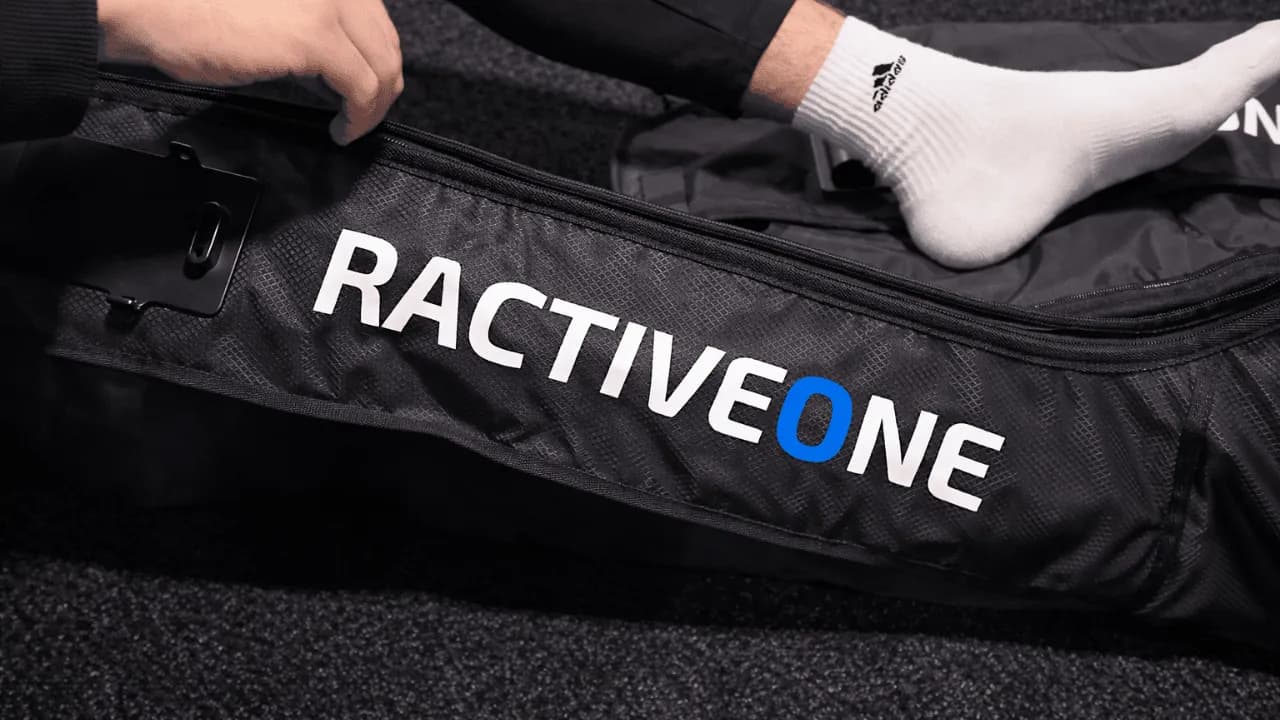
This guide gives you protocols for long rides, interval sessions and multi-day trips, with minutes, pressure levels and what to eat. And I will tell you honestly what studies on cyclists show, and what they do not.
A long ride feels different in the evening from a hard run. Your quads are heavy and your calves are tired, but the sharp muscle soreness often never arrives. That comes down to the type of load, and it changes what you should focus on when you recover. How compression boots work mechanically is covered in our guide on how compression boots support recovery. The basics of sleep, food and rest days are in the complete guide to recovery after training. This article is about cycling.
Why do your legs feel so heavy after a long ride?
When you pedal, your muscles work almost entirely concentrically: they shorten and push the crank down. The braking, eccentric work that causes small fibre damage when you run downhill or absorb each stride is largely missing. That is why riders get real DOMS after long rides less often than runners do after a marathon.
The fatigue comes from elsewhere: empty glycogen in muscle and liver, fluid loss, hours in the same position and, on climbs or in intervals, high force on every pedal stroke. On top of that, after a long time seated and with tired muscles, blood returns from the legs more slowly. That is exactly where compression comes in. A 2018 study (Zuj et al.) showed that pneumatic compression of the lower leg increases muscle blood flow after exercise.
Worth knowing
For cyclists, recovery starts on the plate. No device refills empty stores. If you want to ride again tomorrow, eat first and put your legs up second.
What do studies on compression in cyclists show?
There are only a handful of studies on cyclists, and if you are hoping for more power, the results are sobering.
- Track simulation: Overmayer and Driller (2018) had 21 trained cyclists ride for 20 minutes, recover for 30 minutes with pneumatic boots or passively, then do a 4-minute time trial. Performance did not differ. Riders rated their recovery slightly better with the boots, but the difference was not significant.
- Ergometer sprints: Martin et al. (2015) tested 14 active adults with two 30-second sprints on a bike, followed by 30 minutes of compression or a sham treatment. Blood lactate fell faster with compression, but power in the next sprint was the same.
What that means for you: between two races on the same day, boots will not make you faster. Their place is the evening after a long or hard session, when you want to take the load off your legs and actually lie down. What the research on recovery boots shows overall is summarised in the benefits of compression boots according to studies.
What should you eat after the ride?
After a long ride, food is your most important recovery tool. The American College of Sports Medicine position stand (Thomas et al. 2016) gives clear guide values:
- Carbohydrate: if you ride again within a day, for example on a training camp, 1.0 to 1.2 g per kg of body weight per hour for the first four hours. For a 70 kg rider that is 70 to 85 g an hour: rice, pasta, bread, fruit.
- Protein: a portion of around 0.3 g per kg of body weight soon after the ride, so roughly 20 to 25 g.
- Fluid: weigh yourself before and after long rides. Drink back what you lost over the next few hours, with a little salt in your food or drink.
Protocol after a long ride
For rides of three to four hours or more, sportives or long club runs at the weekend. Pressure levels refer to the Revive Active recovery boots with 7 pressure levels between 30 and 240 mmHg; on other devices, choose the lower to middle range.
| When | What you do | Boots |
|---|---|---|
| Straight after the ride | drink, eat carbohydrate and protein, get out of wet kit | not yet |
| 1–3 hours later | shower, proper meal | 20–30 minutes, level 2–3, wave or sequential |
| Evening | early night, plenty of sleep | optional extra 15 minutes if legs feel very heavy |
| Next day | 30–60 minute easy spin, small gears, no efforts | 20 minutes in the evening, level 2–4 by feel |
Protocol after intervals and hill repeats
Threshold intervals, VO2max blocks or repeated climbs are shorter, but the force per pedal stroke is higher. Quads and glutes are often tight afterwards.
- Cool-down: 10–15 minutes of easy spinning after the last interval.
- In the evening: 15–20 minutes in the boots, level 2–4.
- Add local work: for single tight spots in the glutes, front of the thigh or calf, a massage gun is more targeted. Which device helps more and when is explained in compression boots vs massage gun.
How do you recover between stages and on a training camp?
On a spring camp in Mallorca, a week of Alpine climbs or a multi-day sportive, you ride several days in a row. What counts is what you manage between finishing and the next start. A daily routine that works:
- First 30 minutes: recovery drink or food with carbohydrate and protein, plus fluid.
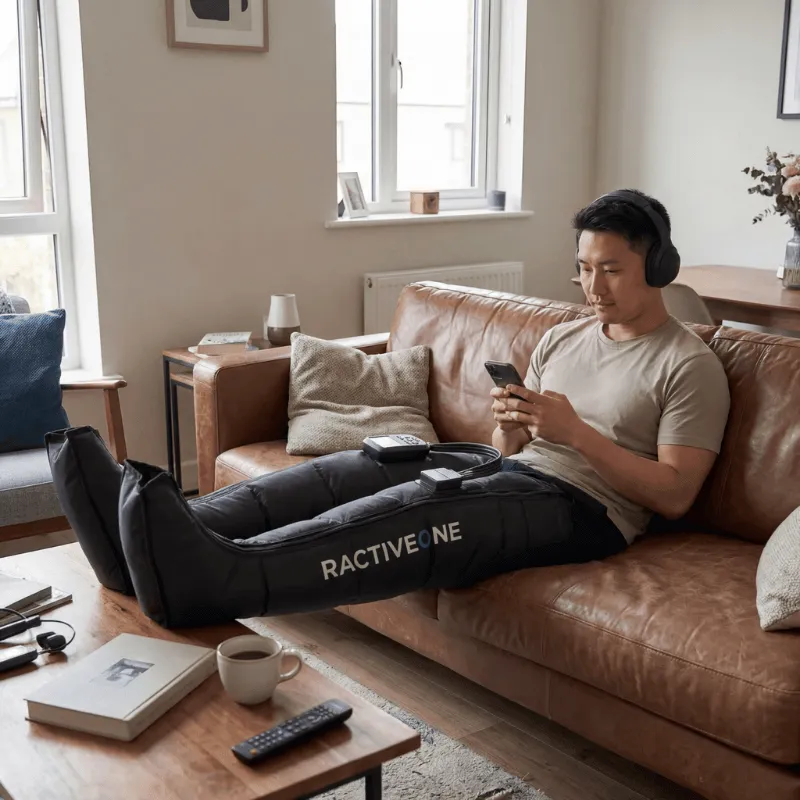
- Before dinner: shower, then 20–30 minutes in the boots at level 2–3. The controller runs on a battery and the boots fit in your luggage.
- Dinner: plenty of carbohydrate so your stores are full by the morning.
- Sleep: more important than any device. An hour earlier to bed beats another session.
- Rest day after three or four days: an easy hour and boots in the afternoon make more sense than doing nothing at all.
“On training camps I see the same mistake every year: riders lie on the bed in their boots before they have eaten. Fill the tanks first, then look after the legs. And on day four, a short easy spin beats sitting still.”
Daniel Volpe, coachWhich settings suit cyclists?
- Pressure: start low. After long rides, level 2–3 is enough; after short hard sessions, up to level 4. Tingling, numbness or pain means turn it down straight away.
- Mode: wave or sequential, working from the foot upwards. The Revive Active has 5 modes; for cyclists these two usually cover it. Whether 4 chambers are enough or 8 suit you better is covered in Revive Active vs Pro compared.
- Duration: 15, 30 or 45 minutes can be selected. 20 to 30 minutes is normal.
- Position: lying down with legs slightly raised. If your lower back is stiff from the saddle, put a cushion under your knees.
General guidance on duration and frequency for any sport is in how to use compression boots: how long and how often. If you also run or race triathlon, see our compression boot protocols for runners, because legs are more sensitive after running than after riding. If winter means more functional training, the routine in recovery between Hyrox training blocks fits well, and if you still play at the weekend, there is a separate plan for football recovery after a match. How to spread recovery across the cycling year, from winter base to summer sportives, is set out in our recovery calendar 2027.
How do recovery boots fit into a cycling week?
| Day | Session | Boots |
|---|---|---|
| Tuesday | intervals or hill repeats | 15–20 minutes in the evening |
| Thursday | endurance ride, 2–3 hours | optional |
| Saturday | long ride, 4–5 hours | 20–30 minutes in the evening |
| Sunday | club run or second long ride | 20–30 minutes in the evening |
| Monday | rest day | 20 minutes if legs feel heavy |
Two to four sessions a week are enough. Whether they help you becomes clear after a few weeks of a fixed routine, not after one evening.
What mistakes do cyclists make with recovery?
- Not eating enough after long rides. Start the next day with empty stores and your legs will feel heavy, however long you spent in the boots.
- Boots instead of a rest day. Even with compression, your body needs days off.
- Too much pressure. More pressure does not mean more recovery. Comfortable is the right level.
- Ignoring pain. Knee pain, numb feet or a sharp pain in the calf are not a job for the boots. Have them checked by a doctor.
Which cyclists are compression boots (not) right for?
A good fit if you
- ride eight hours or more a week
- are planning a training camp, Alpine climbs or a stage event
- regularly have heavy legs after long rides
- want a fixed evening routine that gets you lying down
Not, or only after medical advice, if you
- have had a thrombosis or one is suspected
- have heart failure or circulation problems
- have open wounds, inflamed saddle sores on the thighs or fresh injuries
- are pregnant
If you mostly ride two hours at the weekend, you do not need boots. Food, sleep and a rest day are enough. If symptoms do not ease within a few days, always get them checked by a doctor. Which conditions rule out compression is set out in compression boot contraindications explained.
Conclusion
After long rides and stages you recover mainly through carbohydrate, fluid and sleep, and compression boots in the evening can make your legs feel noticeably lighter. They are most useful for riders with high weekly hours, training camps and multi-day events. Studies on cyclists show no performance gain, so boots add to food, sleep and rest days rather than replacing them.
Frequently asked questions
How long does it take to recover from a long bike ride?
What helps heavy legs after cycling?
Are compression boots worth it for cyclists?
When should I use recovery boots after a ride?
Is a TENS unit useful for cyclists?
Should I get DOMS after a long ride?
Sources
- Overmayer, R. G. & Driller, M. W. (2018). Pneumatic Compression Fails to Improve Performance Recovery in Trained Cyclists. International Journal of Sports Physiology and Performance, 13(4), 490–495.
- Martin, J. S. et al. (2015). Acute Effects of Peristaltic Pneumatic Compression on Repeated Anaerobic Exercise Performance and Blood Lactate Clearance. Journal of Strength and Conditioning Research, 29(10), 2900–2906.
- Zuj, K. A. et al. (2018). Enhanced muscle blood flow with intermittent pneumatic compression of the lower leg during plantar flexion exercise and recovery. Journal of Applied Physiology, 124(2), 302–311.
- Thomas, D. T., Erdman, K. A. & Burke, L. M. (2016). American College of Sports Medicine Joint Position Statement. Nutrition and Athletic Performance. Medicine & Science in Sports & Exercise, 48(3), 543–568.