Humidity and colds: what dry indoor air does to viruses, airways and sleep
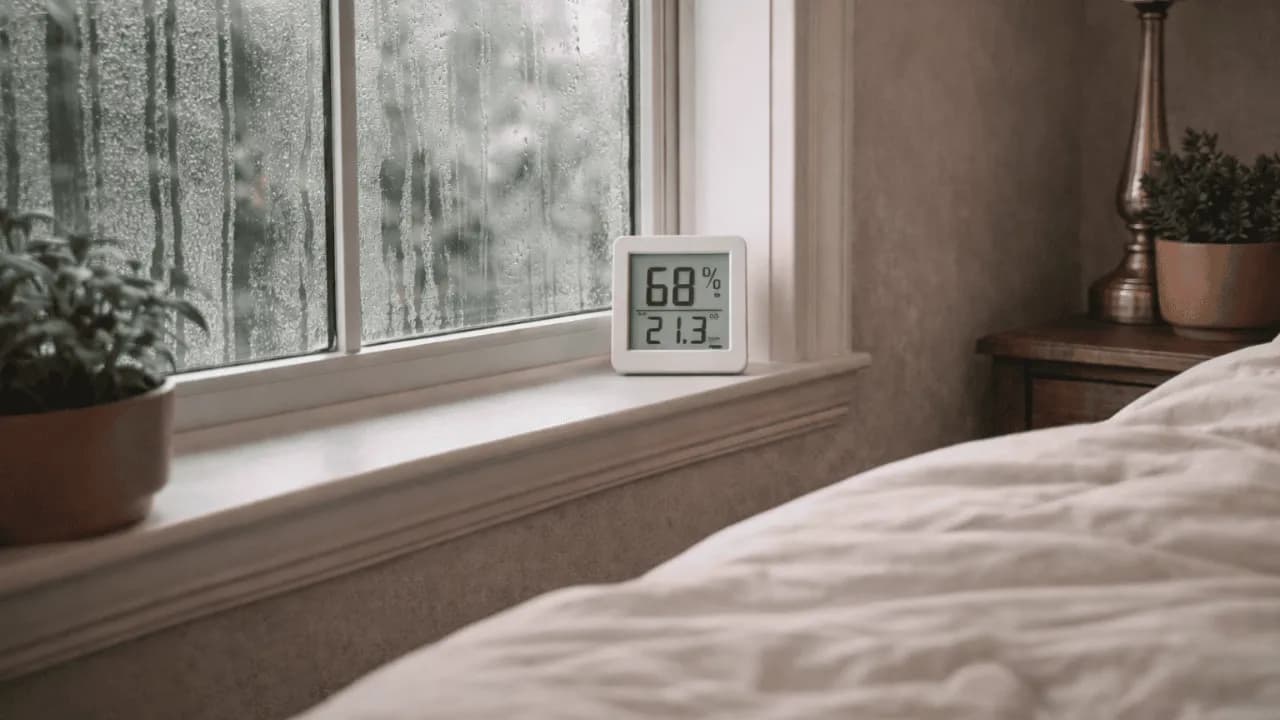
Humidity and colds are linked more closely than most people think, but not in the way adverts suggest. Once the heating is on, indoor humidity in many homes drops below 30%. Your nose, throat and eyes feel dry, and it is cold and flu season at the same time. Lab experiments show flu viruses stay infectious for longer in very dry air.

Animal studies show dry air weakens the airways' own cleaning system. None of that means a humidifier will keep you from catching a cold. This article explains what the studies actually measured, why winter air is so dry and how to reach sensible levels at home.
This article is part of our main guide how to use a humidifier: 9 common mistakes. That guide covers settings and care. This one answers a question that comes up every autumn: does dry, heated air have anything to do with colds? The short answer: there are good clues, but no proof that a humidifier keeps you healthy.
Why is heated indoor air so dry in winter?
You need two terms for this. Absolute humidity is how much water vapour is actually in the air, in grams per cubic metre. Relative humidity is how full the air is compared with the most it could hold, in per cent. A hygrometer, the small meter for humidity, always shows relative humidity.
That maximum depends on temperature. Warm air can hold far more water than cold air. Think of cold air as a small cup and warm air as a big bucket. Pour a full cup into the bucket and the bucket is still almost empty.
| Air temperature | Maximum water vapour (saturation) |
|---|---|
| −10 °C | 2.36 g/m³ |
| 0 °C | 4.85 g/m³ |
| 5 °C | 6.8 g/m³ |
| 10 °C | 9.4 g/m³ |
| 15 °C | 12.83 g/m³ |
| 20 °C | 17.3 g/m³ |
| 25 °C | 23 g/m³ |
The figures come from the vapour density table published by HyperPhysics at Georgia State University. Here is a worked example. Outside it is 0 °C with 80% relative humidity. That air holds about 3.9 grams of water per cubic metre (80% of 4.85). You open the window, and the heating warms that air to 20 °C. The 3.9 grams stay the same, but now 17.3 grams would be possible. Relative humidity drops to around 22%. On a frosty day at −10 °C and 90% outside, you end up at about 12% indoors.
That is why a damp, foggy British winter can still leave your flat feeling dry. You cannot judge it reliably by feel: humans have no sense organ for humidity (Wolkoff 2024). You need a meter.

What do studies show about humidity and flu viruses?
It matters what kind of study you are looking at. A lab experiment shows what happens under controlled conditions. An animal study shows what happens in a mouse. Neither tells you for certain what happens in your living room.
Lab study: flu viruses in coughs
Researchers at the US National Institute for Occupational Safety and Health (NIOSH) built a mock examination room. One manikin coughed out flu virus, a second one "breathed" it in. Humidity ranged from 7 to 73%. At 23% or less, 71 to 77% of the collected virus was still infectious after an hour. At 43% or more, only 15 to 22% was. Most of that loss happened within 15 minutes of the cough (Noti et al. 2013).
Data analysis: absolute humidity and flu season
Two researchers reanalysed earlier lab experiments on flu viruses. They found that absolute humidity, the real amount of water in the air, explained the results much better than relative humidity. It explained about 90% of the variation in virus survival and 50% in transmission (Shaman and Kohn 2009). Because absolute humidity is lowest in winter, indoors and out, this may help explain the flu season. The authors themselves call it a hypothesis that needs more testing.
Animal study: dry air and the airway lining
Your airways clean themselves. Tiny hairs called cilia push a thin layer of mucus, with trapped particles and germs, up towards the throat. Scientists call this mucociliary clearance. In an experiment at Yale University, mice were kept in low humidity and then infected with flu. They became more seriously ill. Their airways cleared less well and the defence in their lungs was weaker (Kudo et al. 2019). These were mice, not people. According to the paper's disclosure, the work was partly funded by a gift from a humidification company.
What this means for you
The studies point the same way: very dry air seems to help flu viruses and weaken the defences in your airways. But the effect has only been shown in the lab and in animals. No large study has shown that a humidifier at home prevents infections.
Are there real-world studies?
A few, and they are small. Researchers at the Mayo Clinic in the US humidified two of four preschool classrooms from January to March. In the humidified rooms they found clearly fewer flu viruses in the air and on toys. The rooms without humidification had 2.3 times as many flu-like illnesses (Reiman et al. 2018). The authors say themselves that the number of sick children was small and that it is not clear whether humidification was the cause. One of the authors worked for a company that makes humidification systems.
An older review pulled together nine observational studies from offices, homes and schools. Mid-range humidity went along with fewer respiratory infections and sick days than very low or very high humidity (Arundel et al. 1986). Observational studies show a link, not a cause.
And if you already have a cold? A Cochrane review, a particularly careful summary of all good trials, looked at six trials with 387 people who breathed warm, humid air to treat a cold. It found no clear benefit, and the evidence was of low quality (Singh et al. 2017). A humidifier is not a treatment.
What does dry air do to your nose, throat and eyes?
This is where the evidence is most useful day to day. In a Japanese lab study, young and older men sat at 25 °C and 10, 30 or 50% humidity. At 30%, eyes and skin already became measurably dry. At 10%, the lining of the nose dried out too. The older men noticed the dryness in their nose less, even though they were more affected (Sunwoo et al. 2006).
A recent review by the Danish researcher Peder Wolkoff concludes that dry indoor air increases eye and airway complaints in offices. It slows the airways' self-cleaning and can reduce work performance. He names 40 to 60% relative humidity as the favourable range (Wolkoff 2024).
Plenty of people who work at a screen in winter complain of dry eyes. According to Wolkoff, several things play a part: low humidity, pollutants in the indoor air and working habits. Humidifying can be one piece of the puzzle, but not the only one. Eyes that burn or stay red for a long time need an optician or eye doctor to look at them.
Why does bedroom humidity matter so much?
You spend seven to nine hours in a row in your bedroom, usually with the window shut and often breathing through your mouth. Many people wake up in winter with a dry throat or a blocked nose. One review notes that humidified air seems to reduce nasal symptoms in people with sleep apnoea, meaning pauses in breathing during sleep (Wolkoff 2018).
At the same time, the bedroom is often the coolest room, and cool walls attract condensation. So a humidifier in the bedroom must not be set too high. Which levels make sense at night and how to measure properly is covered in detail in our article on the ideal bedroom humidity for sleep.
What humidity should you aim for?
| Relative humidity | Rating | What to do |
|---|---|---|
| below 30% | very dry, eyes and skin dry out | humidify, check room temperature |
| 30–40% | dry | humidifying can feel more comfortable |
| 40–50% | target range in the heating season | leave it, keep airing |
| 50–60% | still fine | watch cold outside walls and window corners |
| above 60% | too damp, mould risk rises | humidifier off, air more often |
A widely cited review set the range at 40 to 60%. Dust mites multiply least below 50%, and most moulds only grow above 60% (Arundel et al. 1986). The upper limit matters as much as the lower one. The World Health Organization links persistent damp and mould in homes with more respiratory symptoms, allergies and asthma (WHO 2009). UK government guidance adds that damp and mould mainly affect the airways and lungs, and that children, older people and people with health conditions are at greater risk. Too damp is not a harmless opposite of too dry.
How do you measure properly?
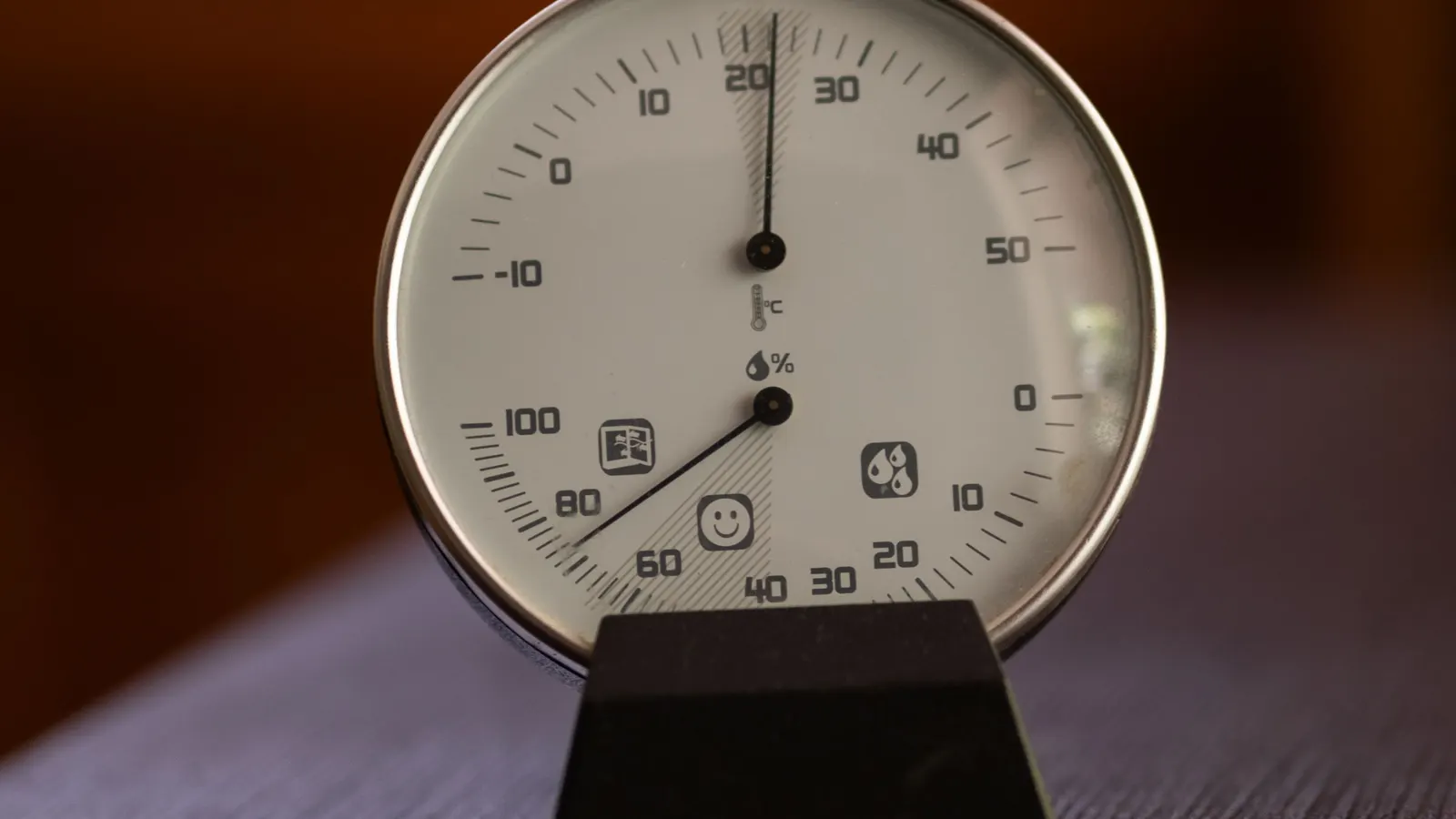
- A simple digital hygrometer is enough.
- Put it at table height in the middle of the room: not by the window, the radiator or the humidifier.
- Measure over several days, morning and evening. One reading after a shower tells you little.
- Compare rooms: bedroom, living room, children's room. Often only one room is too dry.
- Cheap meters can be a few per cent out. Watch the trend, not the decimal point.
Airing in winter: doesn't that make the air even drier?
Yes, a little. It still matters. Fresh air dilutes stale air, smells and virus-laden droplets. Germany's Environment Agency recommends opening windows wide two to three times a day for about five minutes per room in cold weather, depending on temperature and wind, with the heating turned down while you do it. A window left on the latch for hours mainly chills the wall next to it and can encourage mould there.
So the order is: air first, then humidify if you need to. If you humidify a lot and rarely air, you risk damp walls. If you air a lot and do not humidify, the air will often be dry in very cold weeks. That is normal and usually not a problem.
Plants, laundry, bowls of water: do they help?
- Houseplants release a little water. In a normal room that rarely makes much difference. With lots of plants, you actually need to air more often.
- Drying laundry indoors raises humidity a lot, but you cannot control it. UK guidance on damp and mould suggests drying laundry outdoors where possible. If you must dry indoors, use a warm, ventilated room, not a cool bedroom.
- Bowls of water on the radiator evaporate very little and quickly breed germs if you do not change the water daily.
- A slightly lower room temperature raises relative humidity without any device, because cooler air needs less water to reach the same percentage.
What can a humidifier do, and what can it not?
A humidifier can raise the relative humidity of a room to 40 to 50% in a controlled way. That can make dry eyes, a dry nose and a scratchy morning throat more comfortable. Based on the lab studies, it might also lower how infectious flu viruses in the room air are.
What it cannot do: it does not prevent colds, it does not cure them, and it does not replace handwashing, fresh air or the flu jab. If someone at home is coughing and sneezing, close contact spreads it. A device changes little there.
An ultrasonic humidifier turns whatever is in the tank into mist. The US Environmental Protection Agency (EPA) says ultrasonic models are very efficient at spreading tap-water minerals into the air as "white dust", and that microorganisms often grow in standing water. Rarely, a contaminated humidifier causes an allergic lung inflammation known as humidifier lung: a nationwide survey in Japan counted 430 cases between 2011 and 2021 (Sakamoto et al. 2026). The EPA therefore recommends emptying, wiping dry and refilling the tank daily and cleaning portable units thoroughly about every third day. Step-by-step instructions and advice on which water to use are in how to clean a humidifier.
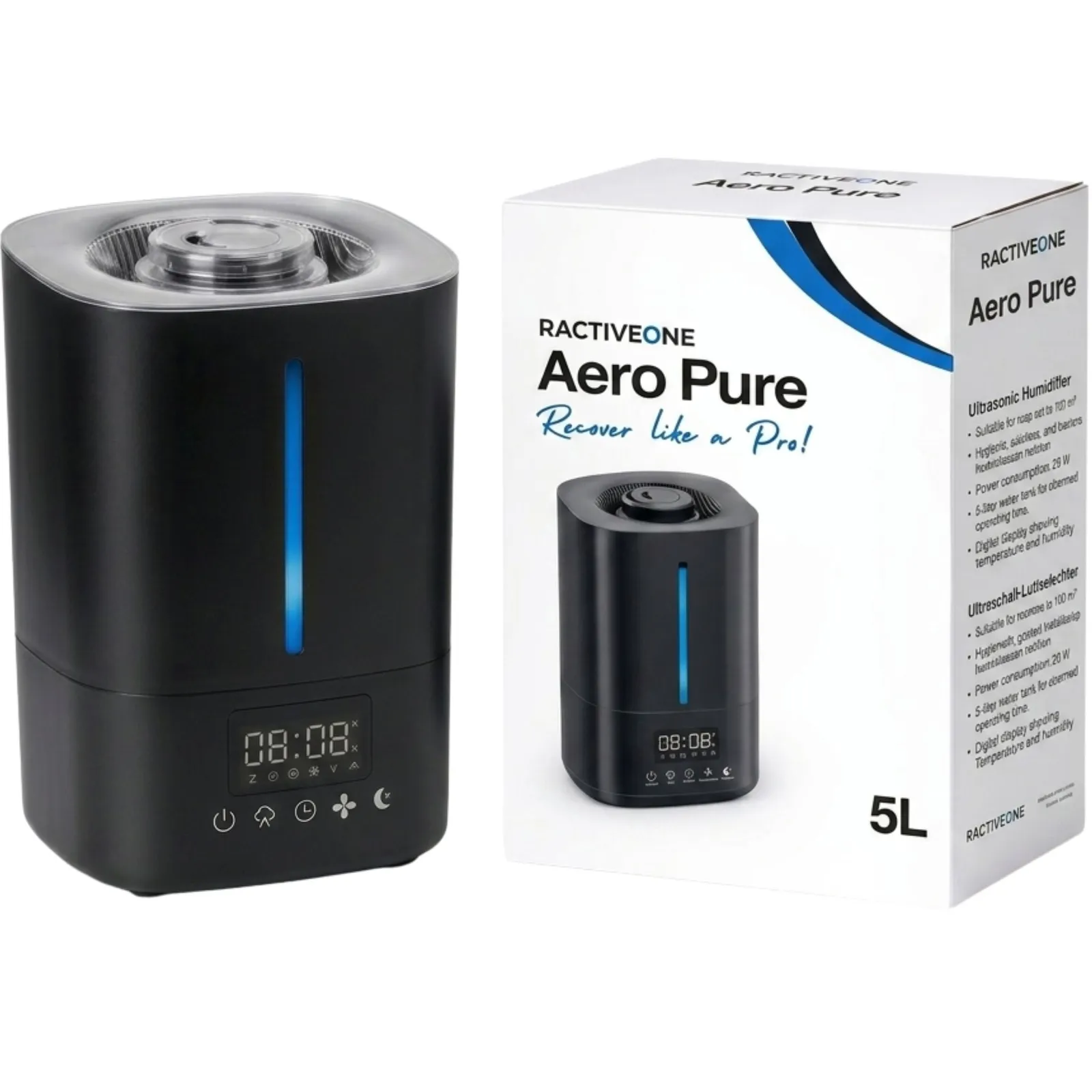
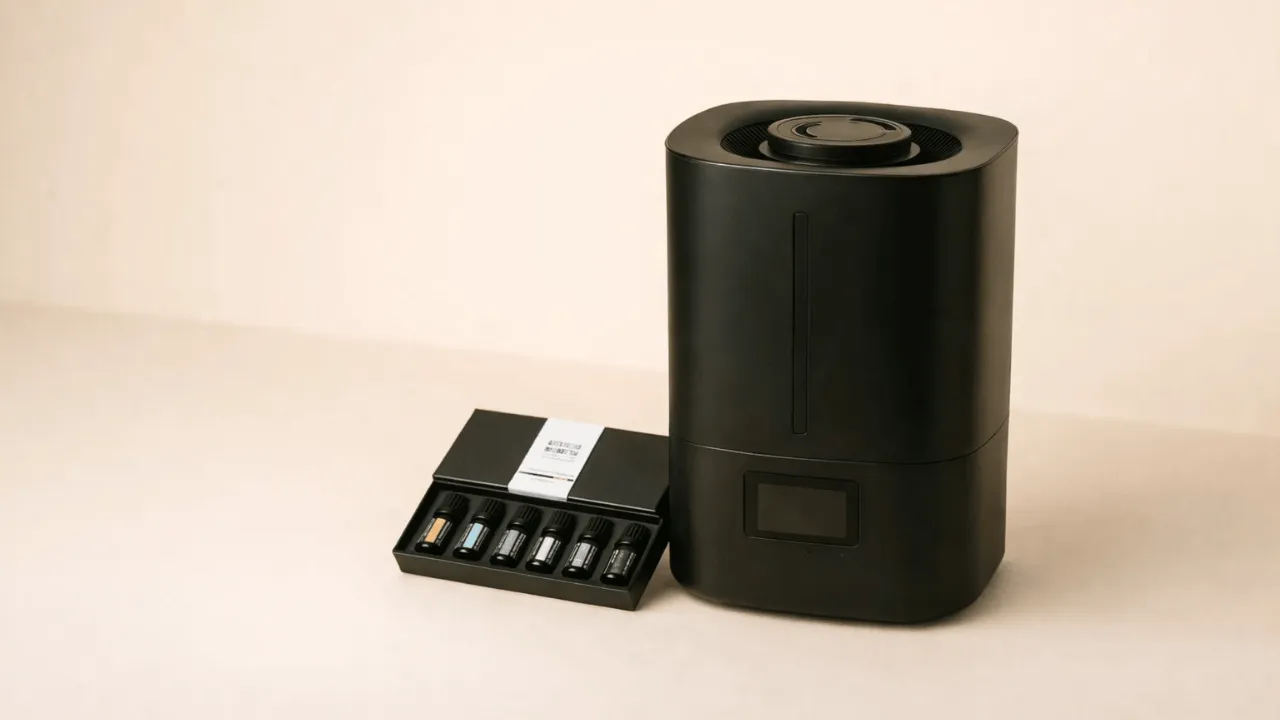
Aero Pure Deluxe
Ultrasonic humidifier with a 5-litre tank, adjustable target humidity from 45%, under 35 dB and automatic shut-off when the tank is empty.
Ractiveone sells the Aero Pure Deluxe, so bear that in mind as you read. According to its specifications it has a 5-litre tank for up to 30 hours, three mist levels and an adjustable target humidity of 45 to 80%. For the heating season, choose the lowest setting, 45%. You do not need higher values at home. It runs at under 35 dB and switches off when the tank is empty. Like every ultrasonic humidifier, it needs fresh water daily and regular cleaning. For context: according to the EPA, evaporative and steam models release fewer minerals and germs into the air than ultrasonic ones. More ways to deal with dry indoor air are in our article dry air at home.
Is a humidifier safe to leave on overnight?
- Cap the target. 45 to 50% is enough. A unit with humidity control switches itself off once it gets there.
- Keep your distance. At least a metre from the bed, raised on a chest of drawers, not right against a cold outside wall and not on wooden furniture that will get wet.
- Fresh water. Refill every evening and pour away what is left in the morning. Never let water stand for days.
- Safety. Automatic shut-off when the tank is empty is sensible for night use. Route the cable so nobody trips over it.
- Air in the morning. Open the window wide for five to ten minutes after you get up.
If you train a lot in winter and sleep badly, our article on the humidifier for athletes has more tips.
"I tell everyone to buy a hygrometer first, not a humidifier. After a week of measuring, a lot of people find their bedroom is not that dry at all, just too warm. And if you do humidify, you have to change the water every day. Otherwise, better not to bother."
Daniel Volpe, coachWhen should you see a GP about a cold?
According to the NHS, most people start to feel better within one to two weeks. The NHS advises seeing a GP if a high temperature lasts more than three days, symptoms do not improve after ten days, a cough lasts more than three weeks, symptoms get worse, you feel short of breath or have chest pain, or you have a long-term condition or a weakened immune system. If you are worried about a child's symptoms, get advice early.
Who a humidifier suits in cold season, and who it does not
A good fit if you
- measure below 40% for days at a time in winter
- often wake up with a dry nose, dry throat or stinging eyes
- work at a screen a lot and your eyes feel irritated by evening
- are willing to refill the unit daily and clean it regularly
Not a fit, or not enough, if you
- have mould, steamed-up windows or readings above 60%. Your air is already too damp.
- want protection from infections. Handwashing, fresh air, distance from sick people and, where recommended, vaccination matter far more.
- have asthma, a mould allergy or a weakened immune system. Talk to your doctor first.
- have breathing problems, fever or a cough that lasts for weeks. That needs medical advice.
Conclusion
Dry, heated air has more to do with cold and flu season than just how it feels: in the lab, flu viruses stay infectious longer in very dry air, and in mice dry air weakens the airways' defences. That does not prove a humidifier will protect you from infections. Humidifying makes sense for anyone whose hygrometer reads below 40% for days in winter and who struggles with dry airways or eyes. Keep to 40–60%, keep airing, clean the unit consistently and see a GP if you have a fever, breathlessness or symptoms that will not go away.
Frequently asked questions
Does a humidifier help with a cold?
What humidity is best when you have a cold?
Why is indoor air so dry in winter?
Is a humidifier safe to leave on overnight?
Should I still open the windows in winter?
Is drying laundry indoors a good way to add humidity?
When should I see a GP about a cold?
Sources
- Noti, J. D. et al. (2013). High humidity leads to loss of infectious influenza virus from simulated coughs. PLoS One, 8(2), e57485.
- Shaman, J. & Kohn, M. (2009). Absolute humidity modulates influenza survival, transmission, and seasonality. PNAS, 106(9), 3243–3248.
- Kudo, E. et al. (2019). Low ambient humidity impairs barrier function and innate resistance against influenza infection. PNAS, 116(22), 10905–10910.
- Reiman, J. M. et al. (2018). Humidity as a non-pharmaceutical intervention for influenza A. PLoS One, 13(9), e0204337.
- Singh, M. et al. (2017). Heated, humidified air for the common cold. Cochrane Database of Systematic Reviews, CD001728.
- Wolkoff, P. (2024). Indoor air humidity revisited: Impact on acute symptoms, work productivity, and risk of influenza and COVID-19 infection. International Journal of Hygiene and Environmental Health, 256, 114313.
- Wolkoff, P. (2018). Indoor air humidity, air quality, and health – An overview. International Journal of Hygiene and Environmental Health, 221(3), 376–390.
- Sunwoo, Y. et al. (2006). Physiological and subjective responses to low relative humidity in young and elderly men. Journal of Physiological Anthropology, 25(3), 229–238.
- Arundel, A. V., Sterling, E. M., Biggin, J. H. & Sterling, T. D. (1986). Indirect health effects of relative humidity in indoor environments. Environmental Health Perspectives, 65, 351–361.
- Sakamoto, S. et al. (2026). Humidifier lung and summer-type hypersensitivity pneumonitis in Japan: a nationwide retrospective observational study. BMJ Open Respiratory Research, 13(1), e003694.
- NHS: Common cold (checked 13.11.2026).
- GOV.UK (DHSC, MHCLG, UKHSA): Understanding and addressing the health risks of damp and mould in the home (updated 1 April 2026).
- Umweltbundesamt (German Environment Agency): Wie lüfte ich richtig? (updated 13.12.2024).
- U.S. Environmental Protection Agency: Use and Care of Home Humidifiers.
- WHO Regional Office for Europe (2009). WHO guidelines for indoor air quality: dampness and mould.
- Nave, R.: Saturated vapor density (table), HyperPhysics, Georgia State University.
- Ractiveone: Aero Pure Deluxe, specifications (5 L, under 35 dB, target humidity 45–80%), as of 13.11.2026.