Ideal Humidity for Sleeping: Bedroom Levels and How to Measure
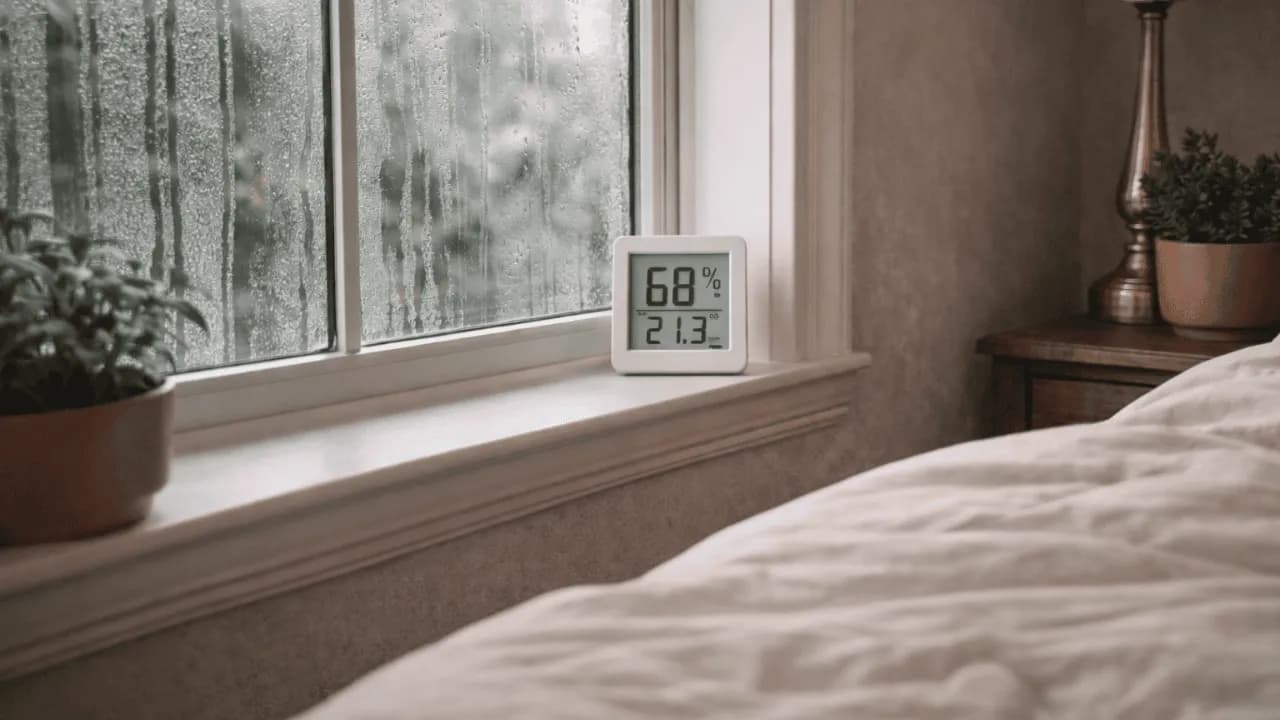
The ideal humidity for sleeping is 40–60 % relative humidity, and in the heating season 40–50 % is the safer target. Simple enough, yet in winter many bedrooms miss it at both ends: too dry at night, then streaming windows in the morning. This article gives you the target values with sources, a table of what each reading means and how to measure properly.
You also get clear steps for both problems, air that is too dry and air that is too damp, and an honest look at what humidity does and does not do for your sleep.
"What level should it be?" is the question we get asked most about indoor air. This article answers it for the bedroom. How to set up, clean and place a humidifier in general is covered in our humidifier tips for beginners.
01. What is the ideal humidity for sleeping?
40–60 % relative humidity, and 40–50 % in the heating season. The 40–60 % range comes from a widely cited 1986 review (Arundel et al.), which found that most unwanted effects of air that is too dry or too damp are minimised in this band. The Centre for Sustainable Energy gives UK households the same range and warns that the risk of mould rises above 60 %. For winter, Germany's Environment Agency is stricter, suggesting below 50 % in poorly insulated homes, and it recommends a bedroom temperature of 17 °C.
| Reading | What it means | What to do |
|---|---|---|
| below 30 % | very dry, typical of heavily heated rooms | turn the heating down a notch, humidify in a controlled way |
| 30–40 % | dry, many people find it uncomfortable | set a humidifier with a humidistat to 45 % |
| 40–50 % | ideal in the heating season | keep it there, air the room each morning |
| 50–60 % | fine in summer and in well-insulated rooms | in winter, watch for condensation |
| above 60 % | risk of mould and dust mites rises | open the windows wide several times a day, humidifier off |
| 65–70 % or more for long periods | too high | check your ventilation habits, look for the cause |
02. Why is the bedroom a special case in winter?
Two things collide in the bedroom. In the evening, after airing, the air is often very dry. By the morning it is damp, because your breath and skin release moisture overnight while the door is shut. Then there is temperature: the bedroom is usually the coolest room in the house, and cooler air reaches a higher relative humidity with the same amount of water in it.
A worked example shows why winter air gets so dry in the first place. Outdoor air at 0 °C and 80 % relative humidity contains about 4 grams of water per cubic metre. Warmed to 20 °C, the same air could hold just over 17 grams. With no other moisture source, relative humidity falls to just over 20 %, and at 17 °C it would be just under 30 %.
The trouble starts at the coldest spots: window frames, the external wall behind the wardrobe, the corners of the room. There the air cools so much that water condenses out. That is why, in winter, 55 % in the middle of the room can already be borderline if the walls are poorly insulated. The UK government's guidance on damp and mould lists condensation as one of the most common causes of damp in homes.
03. How do you measure bedroom humidity properly?
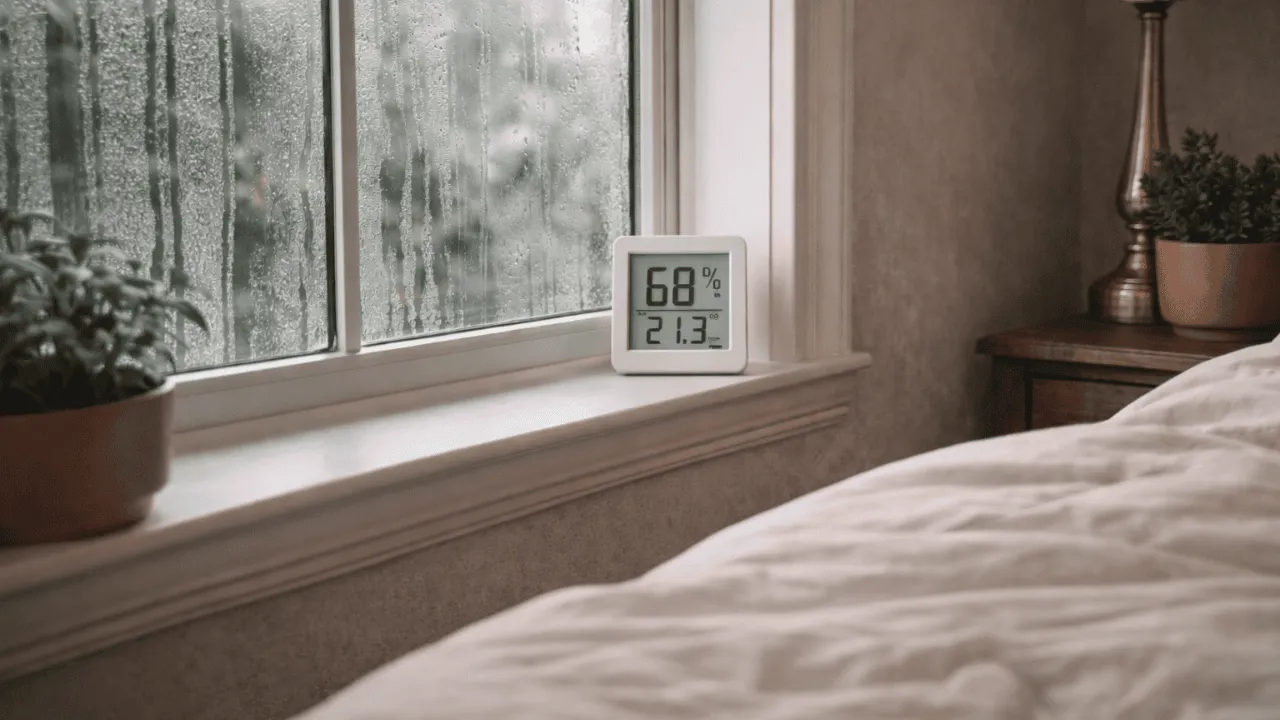
- Use a digital hygrometer. A basic one is fine. If you have two, put them side by side for an hour; if they disagree a lot, use the average as your guide.
- Place it well. In the middle of the room at roughly table height. Not on the window sill, not on an external wall, not next to a radiator or humidifier.
- Read it twice a day. In the evening before bed and in the morning before airing. The morning reading tells you if it gets too damp, the evening one if it is too dry.
- Watch it for a week. Single readings say little. After a week you will know whether you have a dry problem, a damp problem or none at all.
04. What should you do if your bedroom is too damp?
In winter, air that is too damp is the more common and more serious problem. Above 60 %, mould and dust mites do well. The UK government guidance is clear that damp and mould mainly affect the airways and lungs, and that children, older people and anyone with an existing health condition are at greater risk.
- Air the room first thing: windows wide open for 5–10 minutes in winter, with the radiator turned down meanwhile, several times a day.
- Avoid leaving windows on the latch all day: it cools the wall without moving much air.
- Do not let it get cold: keep the room at around 17 °C rather than switching the heating off completely.
- Move furniture away from walls: a few centimetres between wardrobe and external wall lets air circulate.
- Do not dry laundry in the bedroom.
- Switch the humidifier off while the morning reading is above 60 %.
If there is already visible mould, ventilation alone will not fix it. Have the cause checked, and if you rent, report it to your landlord.
05. What should you do if your bedroom is too dry?
If your hygrometer regularly reads below 40 % in the evening, the air is too dry. Typical signs and simple fixes are covered in our article on dry air at home. A 2018 review (Wolkoff) describes how higher indoor humidity can improve perceived air quality and eye discomfort.
- Do not overheat: every extra degree lowers relative humidity further.
- Keep airing: short, wide-open ventilation swaps the air without chilling the walls.
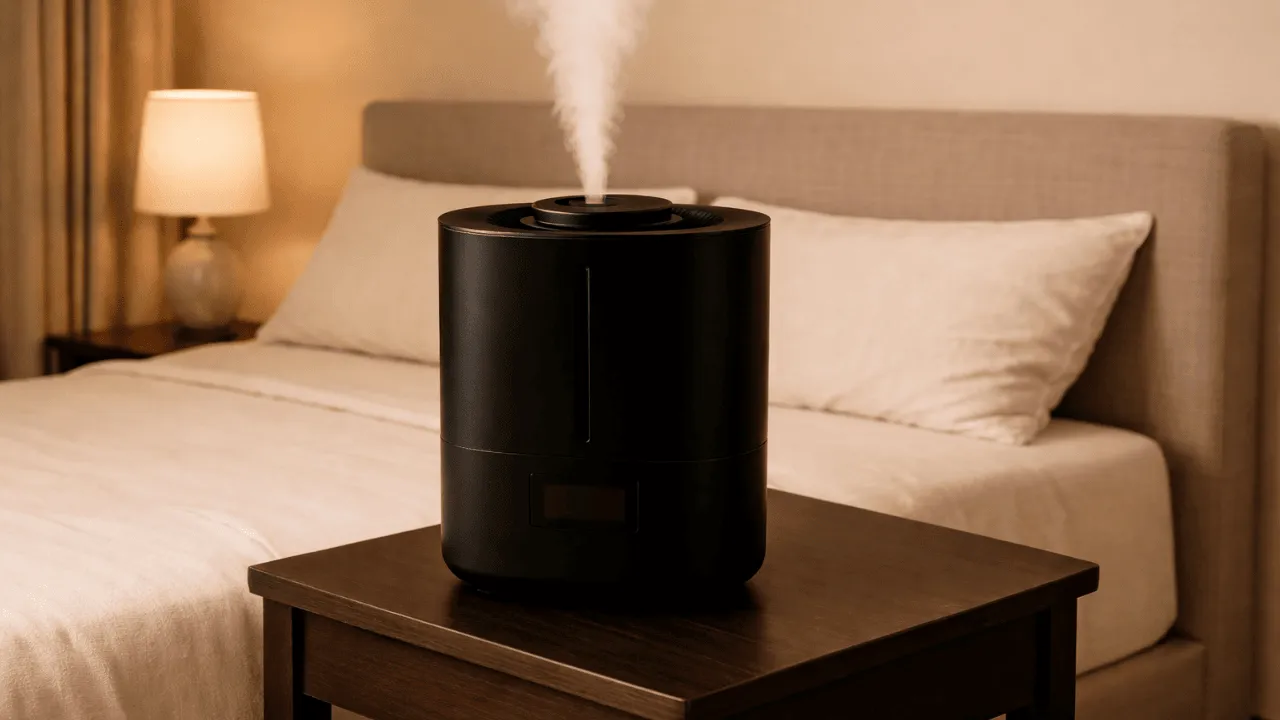
- Humidify in a controlled way: a humidifier with a humidistat raises the level gradually. Set the target to 45–50 %, no higher.
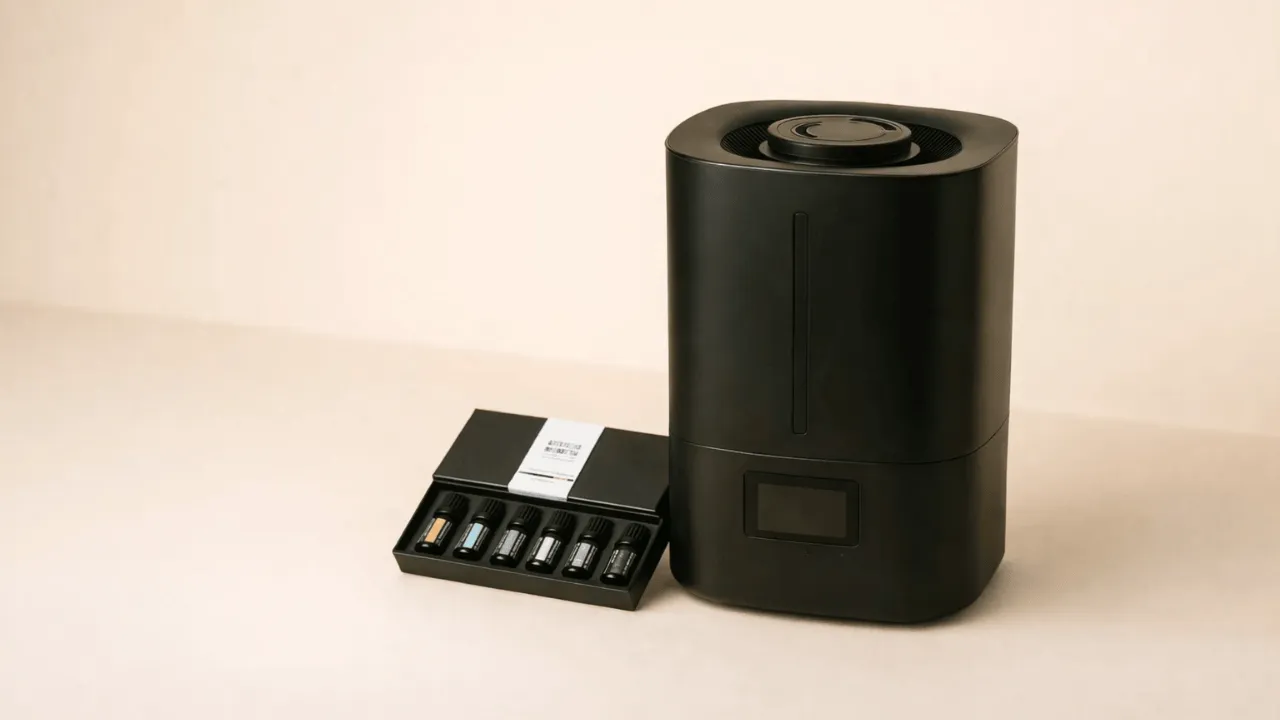
The Aero Pure Deluxe lets you set a target humidity from 45 % upwards and runs at under 35 dB; on the lowest mist setting it is usually enough for a bedroom. Distance from the bed, overnight use and noise are covered in our guide to using a humidifier in the bedroom.
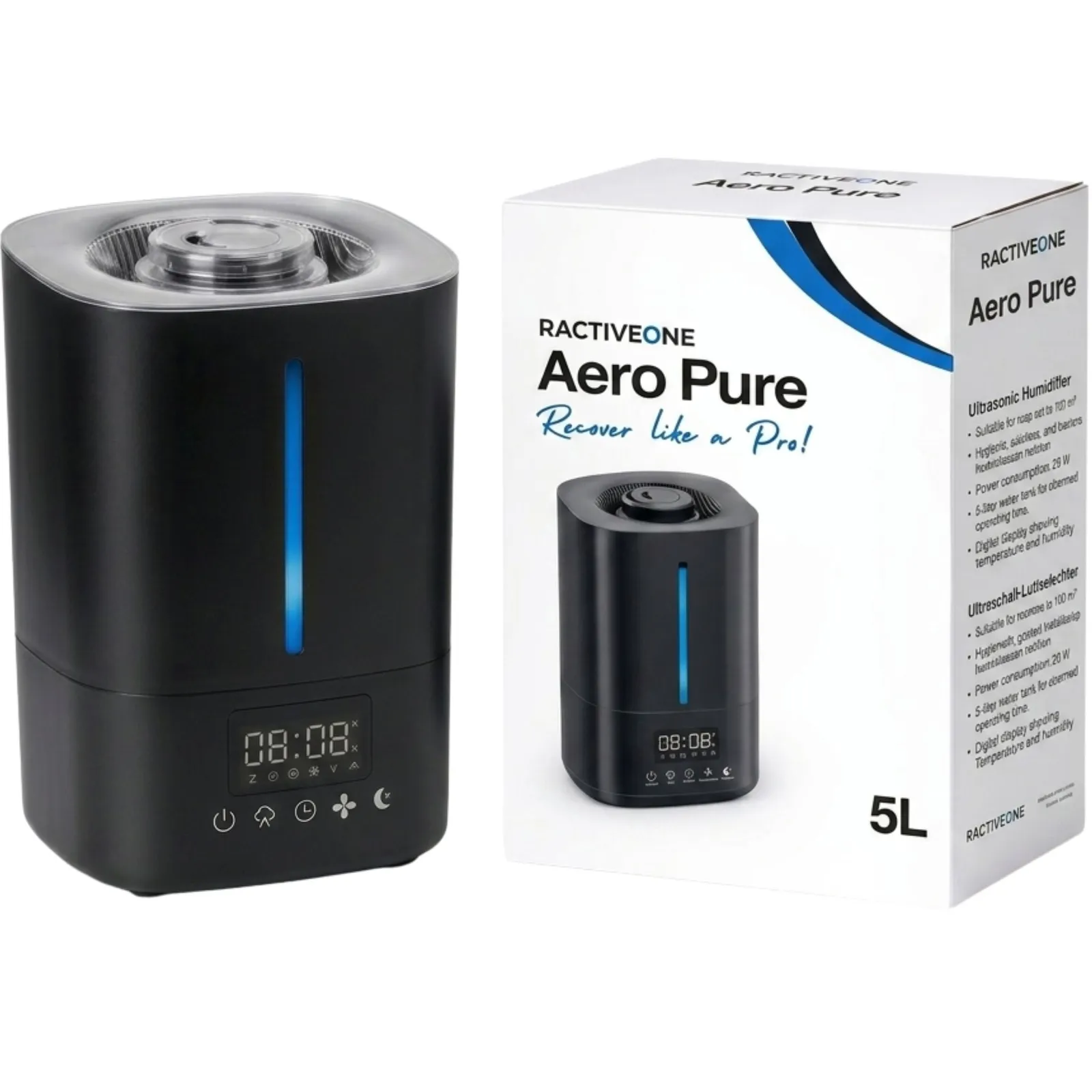
Aero Pure Deluxe humidifier
Target humidity adjustable from 45 to 80 %, under 35 dB and automatic shut-off when the tank is empty.
06. What does humidity mean for your sleep?
To be honest, less than is often claimed. Temperature is well researched. A 2012 review (Okamoto-Mizuno and Mizuno) shows that heat disrupts sleep, and humid heat even more, because the body struggles to shed warmth. For normal winter temperatures, however, there is no evidence that a particular humidity level improves sleep.
What you can realistically expect: people who sleep in very dry air more often wake up with a dry mouth, a dry nose and irritated eyes, which many find unpleasant. Keeping the level in range takes that disturbance away. Beyond that, a cool, dark and quiet room and a regular routine matter for good sleep. If you sleep badly after training, start there. Whether blue light glasses add anything in the evening is weighed up in what studies say about blue light glasses.

07. Who should pay attention, and where are the limits?
Checking a hygrometer is especially worthwhile in older homes with cold external walls, in small bedrooms shared by two people and for anyone who wakes up to wet windows or a dry throat. If you are looking for a device, the buying criteria are in what to look for in a humidifier.
The limits: a humidifier does not treat any respiratory condition, allergy or sleep disorder. If you have asthma, a mould allergy or ongoing symptoms, speak to your GP before changing the humidity in your home.
Conclusion
The ideal humidity for sleeping is 40–60 %, and 40–50 % in the heating season with the bedroom at around 17 °C. It matters most in cool bedrooms in older homes that are too damp in the morning and too dry at night. A good humidity level makes the air more comfortable but is no sleep aid: mould needs its cause fixed, and symptoms need a doctor.
Frequently asked questions
What is the ideal humidity for sleeping?
Is 65 % humidity too high in a bedroom?
Is 35 % humidity too low for sleeping?
Why is bedroom humidity higher in the morning?
What temperature should a bedroom be?
Where should I put a hygrometer in the bedroom?
Does a humidifier help you sleep?
Sources
- Arundel, A. V. et al. (1986). Indirect health effects of relative humidity in indoor environments. Environmental Health Perspectives, 65, 351–361.
- UK Government (DHSC, MHCLG, UKHSA): Understanding and addressing the health risks of damp and mould in the home (updated 2026).
- Centre for Sustainable Energy: Condensation, damp and mould.
- Umweltbundesamt (German Environment Agency): Richtiges Heizen schützt das Klima und den Geldbeutel (updated 24 Oct 2023). – 17 °C in bedrooms; below 50 % humidity in winter in poorly insulated homes
- Okamoto-Mizuno, K. & Mizuno, K. (2012). Effects of thermal environment on sleep and circadian rhythm. Journal of Physiological Anthropology, 31, 14.
- Wolkoff, P. (2018). Indoor air humidity, air quality, and health – An overview. International Journal of Hygiene and Environmental Health, 221(3), 376–390.