How to clean a humidifier and descale it: step-by-step guide
To clean a humidifier properly you need three habits: empty and dry the tank every day, scrub it every third day and descale it roughly once a week, depending on how hard your water is. That sounds like a chore, but in practice it is a few minutes here and there.
Skip it and you get slimy film in the tank, white dust on the furniture and, at worst, germs in the air you breathe all night. This guide gives you the full routine, the household products that work, the ones that must never go in the tank, and the signs that tell you it is time to step up.
Hygiene is one of the nine points in our main guide, humidifier tips and the 9 common mistakes. That article explains why it matters. This one is the how-to: what to do on which day, what you need, and what to leave in the cupboard.
Your cleaning routine at a glance
| Job | How often | What you need | Time |
|---|---|---|---|
| Change the water | daily | cloth, fresh water | 2 minutes |
| Scrub the tank | every 3 days | soft brush, cloth | 5–10 minutes |
| Descale | about weekly, less often with soft water | diluted white vinegar or citric acid | 30 minutes soaking |
| Wipe the outside | weekly | slightly damp cloth | 1 minute |
| End of season | before storing | clean, descale, dry | dry overnight |
The daily and three-day intervals come from the US Environmental Protection Agency (EPA) and apply to portable units like the typical bedroom ultrasonic humidifier. If your manual says something stricter, follow the stricter rule.
Why does cleaning matter so much with ultrasonic humidifiers?
An ultrasonic humidifier does not boil the water. It shakes it into a fine mist, and whatever is in the tank goes into your room with it: minerals from tap water and microbes from any film on the tank walls. According to the EPA, ultrasonic and impeller models release more microorganisms and minerals than any other type.
A case report from Japan shows the extreme end. A 32-year-old woman kept getting fever, a cough and breathlessness. The cause turned out to be an allergic lung reaction to yeasts growing in her ultrasonic humidifier, which had held water for over a year without cleaning (Ando et al. 2017). It is a single case, not a reason to panic. It does show why a clean tank is not optional.
Limescale is more than a cosmetic problem
Scale is rough and gives microbes something to cling to. The EPA names it directly as a breeding ground for microorganisms. Regular descaling keeps the transducer working and the tank hygienic at the same time.
What you need
- a soft, clean cloth that you only use for the humidifier
- a soft washing-up brush or an old soft toothbrush for corners
- cotton buds for the area around the transducer
- white vinegar or citric acid
- optional: 3% hydrogen peroxide from the chemist
- distilled water if you live in a hard-water area
What you don't need: abrasive cream, wire wool, washing-up liquid or any additive for the tank water. More on that below.
Daily: a two-minute water change
- Switch the unit off at the wall and unplug it.
- Take off the lid and pour all the remaining water down the sink.
- Wipe the inside of the tank and lid dry with the cloth.
- Fill with fresh water, replace the lid and switch it back on.
The most common mistake is topping up old water. A big tank makes it tempting because it lasts so long. The Aero Pure Deluxe with its 5-litre tank runs for up to 30 hours according to the manufacturer. That does not mean the water should sit there for 30 hours or more. I empty it in the morning and refill in the evening, so it stands dry during the day.
Every three days: scrub the tank
- Switch off, unplug, pour out the water.
- Scrub the base, walls and lid with the soft brush and a little warm water. Pay attention to corners and seams, where film builds up first.
- Clean around the transducer only with cotton buds or a soft cloth. Never scrape it or use anything hard.
- If your manual doesn't name its own product, the EPA suggests a 3% hydrogen peroxide solution for surfaces that touch water. Leave it for a short while.
- Rinse several times with clean tap water until nothing smells. The EPA stresses this step so that no cleaning residue gets into the air.
- Wipe dry and refill.
A top-fill unit with a wide opening makes this much easier because your hand reaches every corner. With a narrow filler cap you'll need a bottle brush.
How do you descale a humidifier?
With a mild acid that dissolves the scale, followed by plenty of clean water. You probably have what you need in the kitchen already.
With white vinegar
Dilute white vinegar with water, pour it into the tank so the scaled areas are covered and leave it for around half an hour. Loosen what's left with the brush and rinse thoroughly. The manufacturer of the Aero Pure Deluxe names vinegar as the product for its weekly descale.
With citric acid
Citric acid smells less and works in much the same way. Follow the dosage on the pack, use cold or lukewarm water and rinse several times afterwards.
How often?
That depends on your water. In hard-water areas you'll often see a pale ring on the tank floor within a week. With soft water it takes longer. Descale before a layer forms, not when the mist output has already dropped.
“I descale on Sunday evenings, alongside the laundry. Anything with a fixed slot gets done. Anything I do when I feel like it is forgotten by week two.”
Daniel Volpe, coachWhat should never go in the tank?
Anything you wouldn't want to breathe. An ultrasonic unit mists the whole contents of the tank, additives included.
No disinfectant while it runs
In South Korea, products meant to keep humidifier water germ-free were added to tanks for years. A nationwide study linked them to severe lung injury, including deaths (Paek et al. 2015). So never add disinfectant, bleach, fragrance additives the manufacturer hasn't approved, or washing-up liquid to the water the unit runs on.
- Washing-up liquid: foams, is hard to rinse out and gets misted into the room.
- Abrasives and wire wool: scratch the tank and damage the transducer. Scratches give biofilm an even better hold.
- Mineral or spring water: contains minerals just like tap water and does nothing against scale.
- Essential oils without approval: some units can't handle them. The Aero Pure Deluxe can. How much to use is covered in our guide to using essential oils in a humidifier.
Which water makes cleaning easier?
Distilled water. The EPA calls it the best option because it contains almost no minerals. A study from the University of Alberta shows why that matters: an ultrasonic humidifier running on tap water pushed fine particle levels in a test house up to several hundred micrograms per cubic metre, mostly from limescale and sulphate. The harder the water, the more particles (Lau et al. 2021).
For cleaning, that means less scale on the tank floor, less frequent descaling and no white film on dark furniture. Tap water is acceptable if yours is soft, but then you have to descale more consistently. If you're still choosing a model, our 7 criteria for buying a humidifier include what makes one easy to clean.
Looking after the Aero Pure Deluxe
The same rules apply to our own unit, with a few points that come from its design:
- Top fill: take off the lid and you can reach into the tank with your hand and a cloth. No turning it upside down.
- No replacement filter: there's no filter to grow mould or to buy. That doesn't replace cleaning the tank.
- Manufacturer's care interval: wipe it out daily and descale with vinegar once a week.
- Automatic shut-off: it switches off when the tank is empty. A dry tank is good for hygiene, but leave the lid off afterwards so it dries properly.
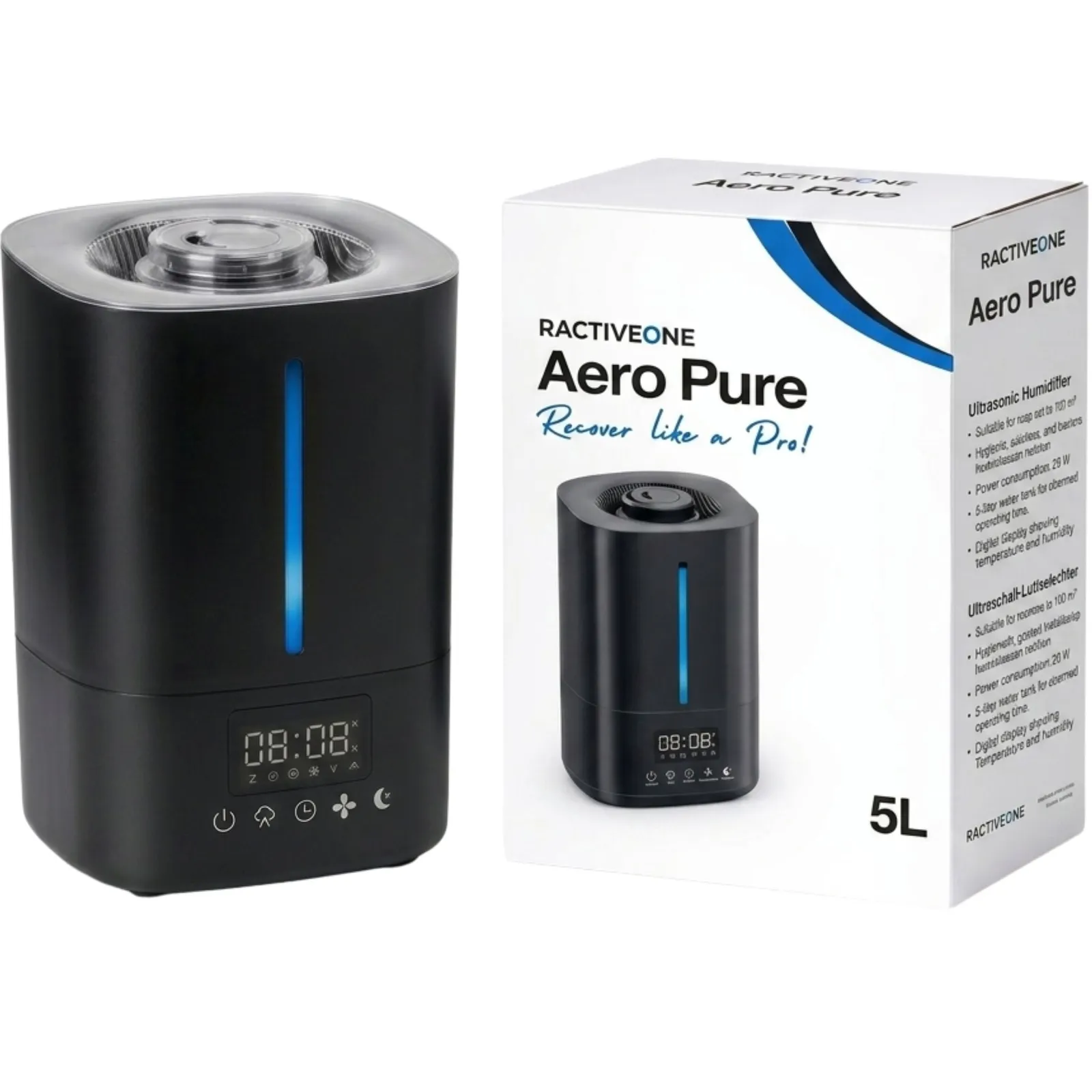
Aero Pure Deluxe humidifier
Wide top opening for filling and cleaning, no replacement filters, automatic shut-off when the tank runs dry.
End of season: storing it properly
- Clean and descale as described above.
- Let every part dry completely with the lid off, ideally overnight.
- Store it somewhere dry and dust-free, for example in the original box.
- Rinse it and dust the outside before the first use in autumn.
That is also the EPA's advice. A unit that spends the summer in the loft with a bit of water in it needs a full clean before it goes back on.
Who the routine suits, and who it doesn't
It suits you if your rooms regularly drop below 40% humidity with the heating on and you're willing to spend two minutes a day and ten minutes every few days. The levels to aim for in your bedroom are in our article on the ideal humidity for sleeping.
It doesn't if you know you won't keep up the care. A neglected humidifier is worse than none. The same goes if humidity is already above 50% or your windows steam up in the morning.
If you develop a cough, fever or breathing problems that might be linked to the humidifier, switch it off and see your GP. The EPA advises the same, even if you've cleaned everything correctly.
Conclusion
You keep a humidifier clean by changing the water every day, scrubbing the tank every three days and descaling with vinegar or citric acid about once a week. It's worth it for anyone who runs a humidifier through the heating season and can make the care a fixed routine. Disinfectant in the tank water is off limits, and no amount of cleaning replaces a doctor's view if you develop symptoms.
Frequently asked questions
How often should you clean a humidifier?
Can I clean my humidifier with vinegar?
Can I run vinegar through a humidifier to keep it clean?
Why does my humidifier smell musty?
What is the white dust around my humidifier?
Can I put essential oils in my humidifier?
How do I store a humidifier over summer?
Sources
- U.S. Environmental Protection Agency: Use and Care of Home Humidifiers (updated 29 April 2026). – Empty and dry daily, scrub every third day, 3% hydrogen peroxide, distilled water
- Lau, C. J. et al. (2021). Particulate matter emitted from ultrasonic humidifiers: Chemical composition and implication to indoor air. Indoor Air, 31(3), 769–782.
- Ando, A. et al. (2017). Hypersensitivity Pneumonitis Caused by a Home Ultrasonic Humidifier Contaminated with Candida guilliermondii. Internal Medicine, 56(22), 3109–3112.
- Paek, D. et al. (2015). Nationwide Study of Humidifier Disinfectant Lung Injury in South Korea, 1994–2011. Annals of the American Thoracic Society, 12(12), 1813–1821.
- Ractiveone: Aero Pure Deluxe, care instructions and specifications (manufacturer information), as of 15 October 2026.