How to Use a Massage Gun: Time, Pressure, Attachments, Body Areas
To use a massage gun properly, keep it short, keep the pressure light and stay on muscle. Most problems come from treating it like a pneumatic drill, staying on one spot for too long or running it over bone and joints.

This guide gives you clear times per muscle, a table for before training, after training and rest days, the five attachments explained and a plain list of the places to avoid. I will also tell you honestly what the research on massage guns shows and where it runs out.
This guide is the starting point for everything we have written about massage guns. If you only want to know when it works best around a session, go straight to massage gun before or after a workout. Here we cover the craft itself: time, pressure, attachments and the right body areas. How a massage gun fits into your wider recovery is set out in our complete guide to muscle recovery.
In this article you will learn:
- what a massage gun actually does and what the studies say
- how to use it step by step
- how long and how often to work on each muscle
- which of the five attachments is for what
- where you should never put it
01. What does a massage gun actually do?
A massage gun drives a head into the muscle in rapid strokes. This is called percussion. Unlike a vibration device, which shakes the surface, a gun pushes the head a little way into the tissue with each stroke and pulls it back. It feels like very fast tapping with a fist, only more even. When a precise vibration device is the better choice is covered in Vibra Grip or massage gun.
What does that achieve? The research is young, but there is usable data. In a 2020 study (Konrad et al.), 16 men had 5 minutes of percussion on their calves. Ankle range of motion went up by 5.4 degrees, a little over 18 per cent, while calf strength did not change. A 2023 systematic review of 11 studies (Ferreira et al.) points the same way: a short-term gain in flexibility, for example in the hip flexors, hamstrings and calves. For jumping, sprinting, balance and agility it found no improvement, and in some cases slightly worse results.
A second 2023 review of 13 studies (Sams et al.) is more positive and also reports acute strength gains and less pain after repeated use. All of the studies, though, had methodological weaknesses. The honest summary: a massage gun is a good tool for mobility and for making muscles feel looser. On current evidence it is not a performance booster.
Worth knowing
Almost every study tests a single session and measures minutes to hours afterwards. What regular use over months does is barely researched.
02. How do you use a massage gun? Step by step
In short: switch it on, choose a low speed, rest the head flat on the muscle, glide slowly without pushing and move on after 30 seconds to 2 minutes. In more detail:
- Choose the head. Start with the round ball. It suits almost every large muscle.
- Switch on first, then make contact. If the gun is already running, you feel straight away whether the speed is right. Switching on against the skin makes the first stroke uncontrolled.
- Start on speed 1. You can always go up. Most people need speed 2 for legs and glutes and stay on speed 1 for the neck and arms.
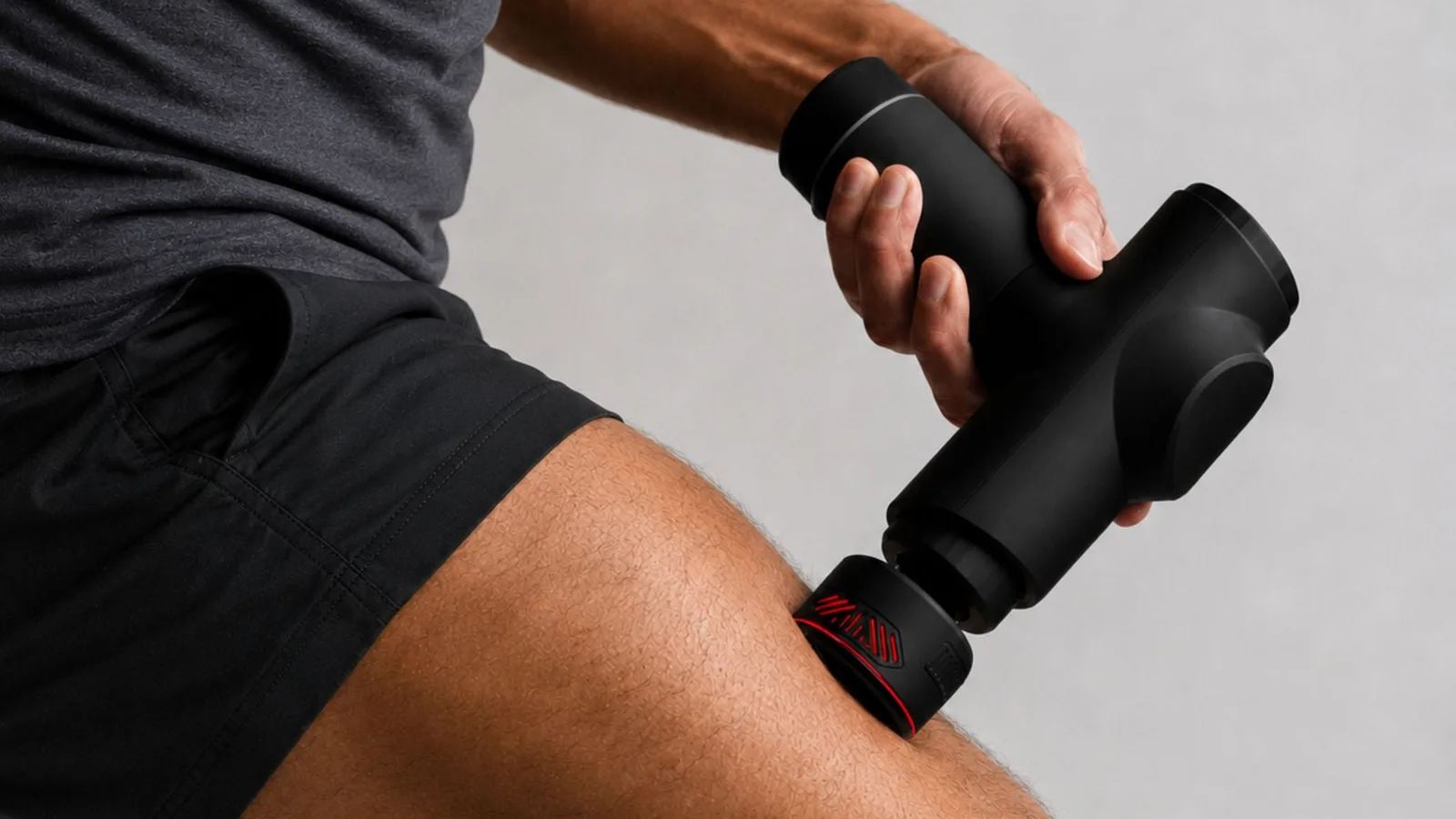
- Keep the head square to the skin. Rest it flat rather than tilted. Hold the handle loosely and let the weight of the gun do the work.
- Glide slowly. Move in calm lines along the muscle fibres, for example from the ankle up the calf. Fast back-and-forth sweeps do very little.
- Pause briefly on tight spots. If you find a hard point, stay for 10–20 seconds, then move on. Do not lean on one spot for minutes.
- Breathe and relax. A tense muscle is hard to treat. Sit or lie so that the muscle you are working on can switch off.

03. How long and how often? A table for everyday use
The key rule: short beats long. Most studies used 5 minutes on one muscle group, which is the upper end. In a 2024 study (Leabeater et al.), 65 active adults used a gun for 5 minutes straight after a hard calf workout. There was no measurable benefit for strength, endurance or calf girth, and soreness was slightly higher in the first four hours. The authors advise caution immediately after hard lower-body exercise.
Putting the research and training practice together gives you this guide:
| Situation | Time per muscle group | Speed | Attachment |
|---|---|---|---|
| Before training | 30–60 seconds | low | ball or flat |
| After training | 1–2 minutes | low to medium | ball, heat/cooling head |
| After a very hard leg session | short and gentle, or a few hours later | low | flat |
| Rest day or evening | 1–2 minutes, 5–10 minutes in total | medium | ball, bullet for tight spots |
| After a long day at a desk | 60 seconds on glutes, chest, upper back | low to medium | ball, fork for the neck |
As for frequency: with healthy muscles you can use the gun briefly every day. If an area feels irritated or tender to touch the next day, you overdid it. Take a day off and go shorter or one speed lower next time.
04. How much pressure should you use?
Less than you think. The gun produces the force itself. If you push on top, you slow the motor and make each stroke harsher, not more effective. I use a scale of 0 to 10: the treatment should feel like 3 to 5, firm but comfortable. From 6 upwards the muscle tenses against it and you get the opposite of what you want.
The Revive Pulse Pro has five speeds from 1,800 to 3,000 percussions per minute. Speeds 1 and 2 are for the neck, forearms, the muscle along the shin and anyone new to it. Speed 3 suits calves, thighs and back. I keep speeds 4 and 5 for glutes and quads after heavy squats, and even then only briefly.
“Contest prep taught me that if the gun hurts, you are working against your own body. I stay on the lowest speed before training and use the middle one at most in the evening. That is plenty.”
05. Which attachment is for what?
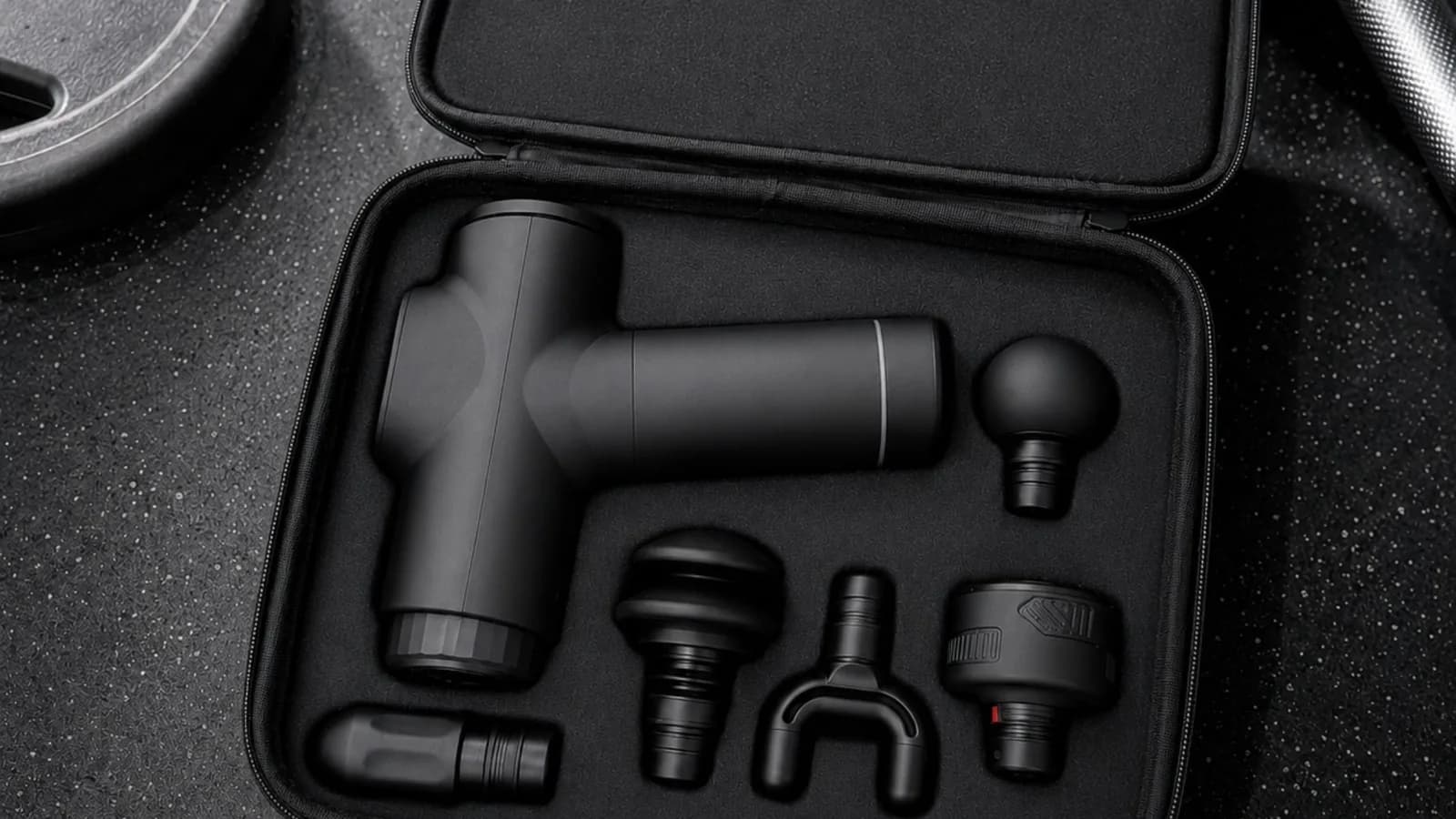
Most massage guns come with four to six heads. The Revive Pulse Pro has four standard heads plus a heat/cooling head. Here is when to use which:
| Attachment | Use it for | Note |
|---|---|---|
| Large flat head | sensitive areas, broad coverage | the gentlest head, good after hard sessions |
| Round ball | thighs, glutes, arms, calves | the all-rounder for beginners |
| Bullet head | single tight spots, trigger points | short bursts only, 10–20 seconds per spot |
| Fork head | neck, calves, muscles beside the spine | the spine sits between the prongs, never under them |
| Heat/cooling head | warmth to loosen up before, cooling after | percussion plus temperature |
Many people overrate the bullet head. It concentrates all the force on a small area, so it gets too much very quickly. What each head does and when to reach for it is covered in massage gun attachments explained. For how to find and treat knots properly, read our guide to releasing trigger points with a massage gun.
06. The key body areas
The basic rule: the more muscle there is, the better the area suits a massage gun. These are the zones I treat most often, with times for a session after training.
Calves
Leg straight, foot relaxed. Work from the heel towards the back of the knee for 60–90 seconds per side, leaving out the Achilles tendon and the back of the knee itself. Runners and footballers will find a dedicated routine in our article on tight calves after running.
Quads and hamstrings
Quads while sitting, hamstrings lying face down or with the leg on a bench, 60–120 seconds each. Keep clear of the kneecap and the groin. Go gently on the inner thigh, where large blood vessels run close to the surface.
Glutes
The most rewarding muscle for a gun: plenty of mass and nothing delicate just under the skin. 60–120 seconds per side, speed 2 is fine. If you sit a lot, this is where you will notice a difference fastest.
Back
Only the muscle either side of the spine, never the vertebrae. On the upper back, work between the shoulder blades. Be very careful on the lower back, where the kidneys sit and the muscle is thinner. Place the fork head so the spine runs between the prongs. The full protocol with times and attachments is in massage gun for your back.
Neck and shoulders
Only the upper trapezius between neck and shoulder, only speed 1, 30–60 seconds per side. The front and sides of the neck are off limits. Our article on using a massage gun for neck tension explains it in detail.
Chest, forearms, soles of the feet
Chest after bench pressing or long hours at a desk: 30–45 seconds, staying off the breastbone. Forearms after climbing or pulling work: speed 1, 30 seconds. Soles of the feet: flat head, speed 1, not on the heel bone.
07. Before or after training?
Both, for different reasons. Before training the goal is activation: 30–60 seconds per muscle on a low speed, then straight into your normal warm-up. The Konrad study shows you do not lose strength by doing this. After training the goal is to relax, and restraint pays off, especially after a hard leg session or a full 90 minutes on the pitch. The full routines are in our guide to the best time to use a massage gun.

Revive Pulse Pro massage gun
5 speeds, 5 attachments including a heat/cooling head, a brushless motor and 3–4 hours of battery life.
08. Where should you not use a massage gun?
Always leave these areas out, whatever the speed:
- bone, joints and tendon attachments: kneecap, shin bone, elbow, heel
- the spine and the ribs directly
- the front and sides of the neck, the head and face
- groin, back of the knee and armpit, where nerves and vessels lie close to the surface
- fresh injuries, strains, bruises, open wounds and inflamed skin
- varicose veins
A 2021 case report (Chen et al.) shows that overdoing it can have serious consequences. A young woman with untreated anaemia developed rhabdomyolysis, a severe breakdown of muscle tissue, after cycling followed by a massage gun session from her coach, and needed hospital treatment. It is a single case. It does show why pain and bruising are warning signs, not a sign that it is working. Every no-go zone, with further case reports and warning signs, is collected in where not to use a massage gun.
Check with a doctor first
If you take blood thinners, have or have had a deep vein thrombosis, are pregnant, have an implant or pacemaker, have osteoporosis or a nerve or circulatory condition, speak to your GP before using a massage gun. The same applies to any pain that does not settle.
09. Who is a massage gun for, and who is it not for?
It suits lifters, runners, footballers, rugby players, Hyrox and CrossFit athletes who want to loosen specific muscles, and anyone who sits all day and feels it in the glutes, chest and upper back by the evening. Its strength is local work: one muscle, one spot, a few minutes.
It is less suited to taking the load off both legs after a marathon or a tournament weekend. For that a gun is too targeted, and compression boots cover the whole leg; our guide on how compression boots work explains the difference, and compression boots vs massage gun shows which helps after which session. And it is no substitute for a diagnosis: pain that has not improved after a week belongs with a GP or physiotherapist. You will find more training and recovery guides in our guide section.
If you do not own one yet, look for several speeds, a range of heads, a strong but quiet motor and decent battery life. The criteria are covered in detail in buying a massage gun: 7 criteria.

Conclusion
You use a massage gun properly when you keep it short, keep the pressure light and stay on muscle: 30–60 seconds per muscle before training, 1–2 minutes after training or on a rest day. It helps athletes and desk workers most when they want to loosen individual muscles and move more freely. The research mainly shows a short-term gain in range of motion; there is no evidence for better jumping, sprinting or reliably less DOMS, and if you have a medical condition, check with your GP first.
Frequently asked questions
How long should you use a massage gun on one muscle?
How often can I use a massage gun?
What speed should I use on a massage gun?
Where should you not use a massage gun?
Does a massage gun prevent DOMS?
Which massage gun attachment is best for beginners?
Should I use a massage gun before or after a workout?
Sources
- Konrad, A. et al. (2020). The Acute Effects of a Percussive Massage Treatment with a Hypervolt Device on Plantar Flexor Muscles' Range of Motion and Performance. Journal of Sports Science and Medicine, 19(4), 690–694.
- Ferreira, R. M. et al. (2023). The Effects of Massage Guns on Performance and Recovery: A Systematic Review. Journal of Functional Morphology and Kinesiology, 8(3), 138. – Systematic review of 11 studies
- Sams, L. et al. (2023). The Effect of Percussive Therapy on Musculoskeletal Performance and Experiences of Pain: A Systematic Literature Review. International Journal of Sports Physical Therapy, 18(2), 309–327. – Systematic review of 13 studies
- Leabeater, A. J. et al. (2024). Under the Gun: Percussive Massage Therapy and Physical and Perceptual Recovery in Active Adults. Journal of Athletic Training, 59(3), 310–316.
- Chen, J. et al. (2021). Rhabdomyolysis After the Use of Percussion Massage Gun: A Case Report. Physical Therapy, 101(1), pzaa199. – Case report of a serious adverse event
- Ractiveone: Revive Pulse Pro specifications (5 speeds, 5 attachments, heat/cooling head), as of 15 Oct 2026.