


How to Use a Massage Gun for Neck Tension and Trigger Points
A tense neck after a day at the desk is rarely random. Trigger points are often behind it – small, hyper-irritable spots inside the muscle. A massage gun for neck tension lets you work on them precisely, without strength or special skills. What matters is the technique.
In short
A massage gun can help you target trigger points in the neck and shoulder area and loosen the feeling of tension. Technique is what counts: scan slowly, hold the firm spot for 20–40 seconds, breathe calmly – then move briefly afterwards. See a doctor if you have severe or persistent symptoms.
In this article you'll learn:
- why trigger points form after long sitting and how they feel
- how three simple steps help you find the right spots
- which body zones benefit most after desk work and training
- what to avoid so your routine stays safe
01. What trigger points are – and why desk work causes them
Trigger points are locally hyper-irritable spots within the muscle tissue. Pressing on one often creates a characteristic referred pain – a pull that radiates into other areas. In everyday language they are simply called "knots".
At the desk they form mainly through three causes: long static sitting, one-sided strain from mouse and keyboard, and chronic stress that keeps the neck muscles permanently tense. The upper trapezius is especially affected – the muscle band running from the shoulder up into the neck.

What a trigger point feels like
The hallmark is a noticeably firm, pressure-sensitive spot in the muscle that feels different from the surrounding tissue. Direct pressure can trigger referred pain into the head, shoulder or arm. This is usually not a sign of serious injury, but a signal that the muscle needs attention.
Good to know
If pain is severe, radiating or persistent, get it checked by a doctor before working with the massage gun.
02. Step by step: using a massage gun for neck tension and trigger points
The most common mistake is too much pressure, too soon. A massage gun works best – and feels best – when you give it time rather than forcing it.


Step 1 – Scan (30–60 seconds)
Start on the lowest setting and glide the device slowly over the area. You're not hunting for maximum pain, but for the spot that feels noticeably firm or "spot-on" tender – clearly different from the tissue around it.
Step 2 – Hold and breathe (20–40 seconds)
Once you've found the spot, stay on it without pressing hard. Breathe slowly and evenly. Let the device do the work. After about 20–40 seconds the tension usually eases noticeably.
Step 3 – Move afterwards (20 seconds)
Right after the treatment, mobilise the area briefly: roll the shoulders, tilt the head gently to the side, stretch the arms. This carries the loose feeling into movement so it lasts longer.
"Recovery doesn't need brute force – it needs precision and patience."
— Ractiveone recovery principle
03. The key body zones at a glance
Not every spot suits a massage gun. These six zones tend to benefit most after desk work and training:
- Neck/shoulder (upper trapezius): 30–60 sec. per side. On the muscle only, never on the throat or vertebrae.
- Shoulder-blade edge (upper back): move slowly along the muscular edge – never directly on the bone.
- Chest muscles (pecs): low to medium intensity, 30–45 sec. per side, then open the arms.
- Glutes and outer hip: scan broadly, hold a firm spot, then mobilise the hip.
- Thighs front/back (quads/hamstrings): 60–90 sec. per side, then 5–8 squats.
- Calves: scan slowly, 30–60 sec. per spot. Not directly on the Achilles tendon or ankle.
"With a massage gun, consistency beats intensity. Short sessions of 5–10 minutes, 3–5 times a week, often do more over time than rare, long sessions."
Marco Reinhardt, Ractiveone editorial team
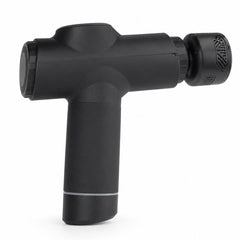
Revive Pulse Pro Massage Gun
Built for targeted trigger-point work – with multiple heads and adjustable speeds.
04. Dos & don'ts for safe use
A massage gun is an effective tool – but only if you follow a few ground rules:
- ✅ Stay on muscle tissue – never on bones, joints or the spine.
- ✅ Start low, then build up – the maximum setting is rarely needed.
- ✅ 20–60 seconds per spot – don't linger for minutes on one place.
- ✅ Firm but controlled – pain is not a progress indicator.
- ✅ Move briefly afterwards – mobilising deepens the effect.
- ❌ Don't use on acute injuries, swelling or inflammation.
- ❌ Stop immediately with numbness, tingling or radiating pain and seek medical advice.

05. Frequently asked questions
How often should I use a massage gun on my neck?
For most people, short sessions of 5–10 minutes, 3–5 times a week, work well. Consistency usually does more than rare, long sessions.
How long should I stay on a trigger point?
About 20–40 seconds per spot. Tension usually eases noticeably in that window – much longer is rarely needed and can become uncomfortable.
Can I use a massage gun directly on my throat?
No. Use the device on muscle only, such as the upper trapezius. The throat, carotid artery and spine are off-limits.
Can a massage gun relieve office neck tension?
A massage gun can help you work on tense muscle areas and subjectively loosen the feeling of tension. It does not replace medical or physiotherapy treatment.
When should I see a doctor instead?
With severe, persistent or radiating pain, or with numbness or tingling. In those cases get it checked before treating yourself.


