Gamer sleep schedule, neck and wrists: an esports routine
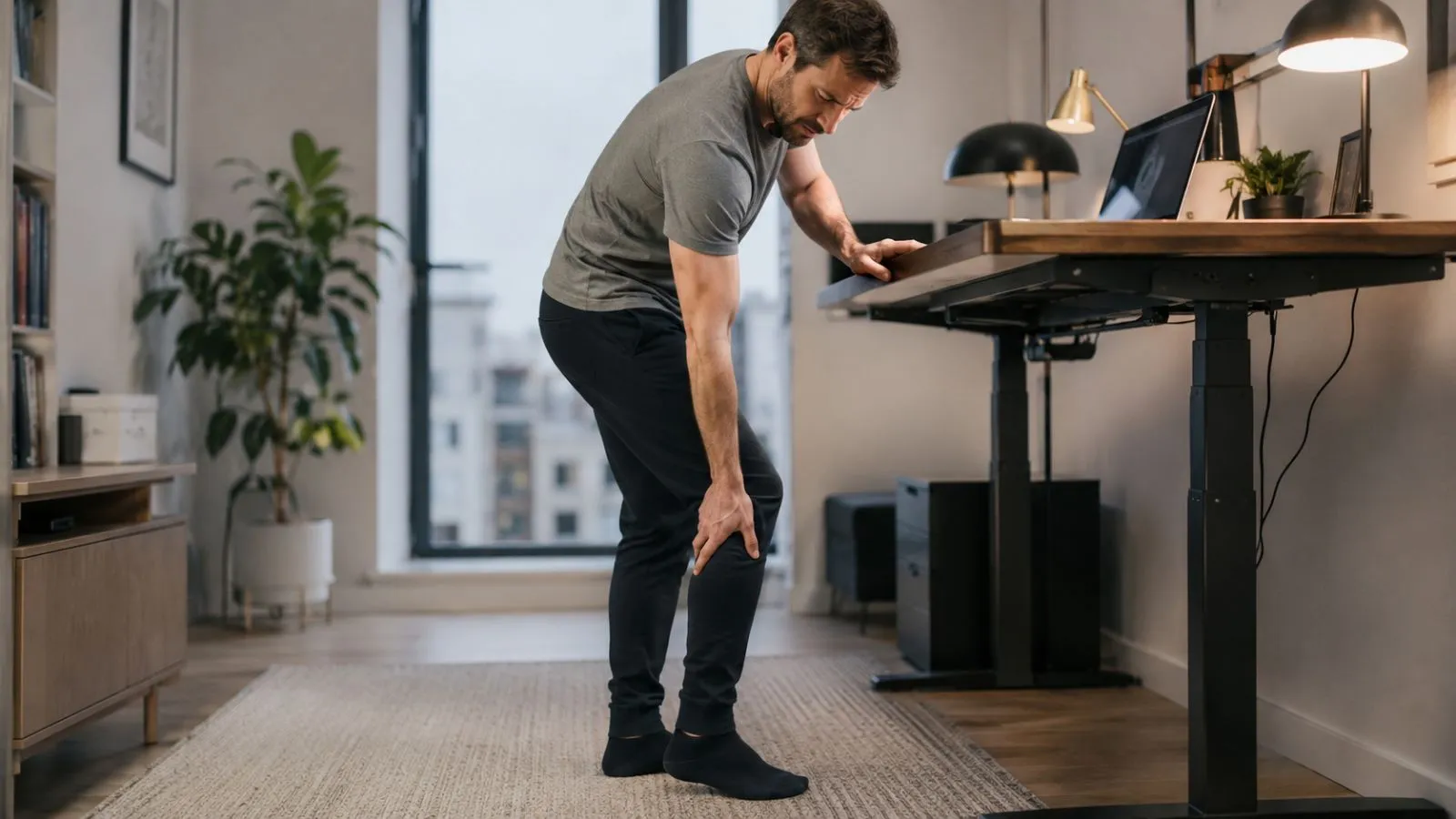
A gamer sleep schedule is usually the first thing to slip. In one study, professional esports players fell asleep at a median of 3:43am, and in a survey of college players 42% reported neck and back pain and over a third wrist pain. The problem is not gaming itself but long sessions with no plan around them.
This guide covers what research on gamers has actually measured and gives you a routine you can start today: a set-up and breaks that spare your neck and wrists, a cool-down after long sessions, and an evening that ends with you actually falling asleep.
This guide is part of our sleep and blue light section. How evening light affects melatonin and your body clock is covered in do blue light glasses really help you sleep. Here we deal with everything else that aches after eight hours at a screen: neck, shoulders, wrists and a brain that refuses to switch off at 2am.
What do studies show about gamers and esports players?
Esports research is young, and most studies are surveys with a few dozen players. Even so, the picture is remarkably consistent.
| Study | Who | Main finding |
|---|---|---|
| DiFrancisco-Donoghue et al. 2019 | 65 college esports players, 3–10 hours of play a day | eye fatigue 56%, neck and back pain 42%, wrist 36%, hand 32%. 40% did no exercise at all. |
| Monma et al. 2024 | 79 players in Japan | stiff shoulders 49%, eye fatigue 48%. Sitting close to the screen and playing mainly on mobile were linked to more neck complaints. |
| Carara et al. 2026 | 60 PC players | 72% reported pain, mostly lower back, wrists and neck. Poor sleep and skipping a warm-up were linked to more pain. |
| Lee et al. 2021 | 17 pros from Korea, Australia and the US | median 6.8 hours of sleep, asleep at 3:43am, up at 11:24am |
One caveat: these are associations, not proof of cause and effect. A survey cannot tell whether poor sleep leads to pain or pain leads to poor sleep. For building a routine, the direction is enough: sleep, set-up and movement are connected.
Gaming and sleep: why your brain will not switch off
Two things keep you awake after playing. The first is arousal. In a Japanese lab study (Higuchi et al. 2005), seven young men played either an exciting game or did a simple task on the same screen until just before 2am. After the game their heart rate was higher, they took longer to fall asleep and had less REM sleep. Screen brightness on its own did not change their sleep in this study.
The second is the clock. In a Belgian survey of 844 adults (Exelmans and Van den Bulck 2015), each extra hour of gaming per day pushed bedtime back by about 7 minutes and getting up by about 14 minutes. The pros in the study by Lee and colleagues slept entirely in the second half of the night and into the late morning.
Light still plays a part, especially over weeks: evening light suppresses melatonin and pushes your body clock later. We worked through what blue light glasses can and cannot do for one big release week in GTA 6 late-night gaming and sleep. That article is a plan for single long nights. This one is about the everyday routine.
Does sleep coaching help esports players?
A study with 56 pros from South Korea, the US and Australia (Bonnar et al. 2022) tested two weeks of sleep education, a one-to-one session and daily feedback. Afterwards, the players fell asleep about 18 minutes earlier according to wrist monitors, and their insomnia scores dropped. Reaction times and mood did not change. Small but measurable steps: that is what realistic change looks like.
Your evening plan
- Fixed finishing time: decide when you stop before you start, not halfway through.
- Calm last game: no ranked matches or new missions in the final hour. Sort your loadout, watch replays or play something gentle.
- Lights down: main light off, monitor dimmer, night mode on.
- Glasses on: our red blue light glasses for the last hours filter 100% of blue light according to the manufacturer and are meant for the 1–2 hours before bed.
- Same wake-up time: even after a late night, do not sleep until lunchtime, or your rhythm drifts further.
For daytime and early-evening sessions, a red tint is impractical. That is what the orange blue light glasses for daytime gaming are for: they filter 99% of blue light according to the manufacturer and change colours less. The full comparison is in red vs orange blue light glasses.
Posture and set-up: what your neck actually needs
The Japanese study gives a clear pointer: players who sit closer to the screen or mostly play on a phone have more neck and shoulder complaints. Your head drifts forward and the neck muscles hold it there for hours. Set up like this:
- Screen: top edge roughly at eye level, at least an arm's length away. If you lean in to read something, the screen is too far or the text too small.
- Chair: back against the backrest, feet flat on the floor, knees at roughly a right angle.
- Arms: elbows close to your body and supported, shoulders relaxed. You only notice shrugged shoulders once your neck has already tightened.
- Phone and handheld: raise the device instead of dropping your head, for example with a cushion on your lap.
Breaks that actually help
There are no tested break intervals for gamers yet. The authors of the Brazilian study recommend warm-ups and micro-breaks, because skipping a warm-up was linked to more pain. My rule of thumb from coaching: stand up for two minutes every 45 to 60 minutes. Between matches, this is enough:
- Roll your shoulders slowly backwards ten times.
- Gently draw your chin back as if making a double chin, hold for 5 seconds, five times.
- Stretch your arms out, palms forward, and gently pull your fingers back with the other hand, 20 seconds each.
- Shake out your hands, walk across the room and look into the distance.
After long sessions: easing your neck and forearms
After a tournament day or a long evening, your neck and forearms often feel tight. Heat and loosening massage help here, with one clear rule: vibration on muscles only, heat and cold on the neck and joints as well.
| Area | Suitable | Not suitable |
|---|---|---|
| Neck | heat, for example 15–20 minutes with the Thermo Flex | vibration |
| Shoulder and upper back muscles | heat, vibration on the muscle bellies | vibration on the spine or shoulder blade edge |
| Forearm | vibration on the muscles, heat | pressure on painful tendons |
| Wrist | heat or cold, whichever feels better | vibration |
The Thermo Flex with heat and cold has three heat settings from 38 to 42 °C and three cold settings down to 5 °C, and it straps in place. So it can sit on your neck while you watch a replay. The Vibra Grip for tight forearm muscles has 10 vibration levels and a fine tip for single tight spots in the forearm muscles. You can use its heat and cooling on the neck and wrist too, but not the vibration. What vibration does in the muscle is explained in vibration massage benefits and how-to, and whether a precise device or a gun suits you better is covered in trigger point massager vs massage gun. When heat makes more sense than cold is explained in our article heat or ice for sore muscles.
"Gamers treat their bodies like spectators, yet their hands and forearms work non-stop. Five minutes of warm-up before the first match and ten minutes of heat afterwards cost almost nothing. Add three workouts a week and your neck will usually notice it sooner than any new mouse."
Daniel Volpe, coachThe full routine at a glance
| When | What | Time |
|---|---|---|
| Before playing | shoulder rolls, hand and forearm stretches, check your set-up | 5 minutes |
| During | stand up and move every 45–60 minutes, drink water | 2 minutes |
| After long sessions | heat on the neck, vibration on the forearm muscles | 10–20 minutes |
| Last 1–2 hours | calm content, dim lights, red glasses | until bed |
| Each week | exercise including back and shoulder work | 2–3 sessions |
Who this routine suits and when to see a doctor
A good fit if you
- play, stream or practise for several hours at a time
- finish sessions with a stiff neck or tired forearms
- struggle to switch off at night and to get up in the morning
- want a routine that takes about ten minutes a day
Please see a doctor if
- your fingers tingle or go numb, or this wakes you at night
- your grip gets weaker or pain spreads into your arm
- neck or wrist pain lasts for weeks despite breaks
- you have slept badly for weeks. Glasses are not a treatment for sleep disorders.
Do not use heat or vibration on fresh injuries, inflamed or swollen areas, or skin with reduced sensation.
Conclusion
Gaming does not have to wreck your sleep or your neck if you take your finishing time, set-up and breaks as seriously as your aim training. Players with long sessions, a stiff neck and late nights who invest ten minutes a day gain the most. Esports research is small and shows associations rather than proof, and tingling, numbness or lasting pain belong with a doctor.
Frequently asked questions
Why can't I sleep after gaming?
How long before bed should I stop gaming?
How do I fix gamer neck?
What helps wrist pain from gaming?
Can I use a vibration massager on my neck?
Red or orange blue light glasses for gaming?
Sources
- DiFrancisco-Donoghue, J. et al. (2019). Managing the health of the eSport athlete: an integrated health management model. BMJ Open Sport & Exercise Medicine, 5(1), e000467. – Survey of 65 college esports players
- Lee, S. et al. (2021). Sleep Characteristics and Mood of Professional Esports Athletes: A Multi-National Study. International Journal of Environmental Research and Public Health, 18(2), 664.
- Bonnar, D. et al. (2022). Evaluation of a Brief Sleep Intervention Designed to Improve the Sleep, Mood, and Cognitive Performance of Esports Athletes. International Journal of Environmental Research and Public Health, 19(7), 4146.
- Monma, T. et al. (2024). Prevalence and Associated Factors of Physical Complaints Among Japanese Esports Players: A Cross-Sectional Study. Cureus, 16(8), e66496.
- Carara, M. M. et al. (2026). Musculoskeletal pain in eSports players: clinical implications for ergonomics, exercise, and preventive physiotherapy. Research in Sports Medicine, 34(4), 423–433.
- Higuchi, S. et al. (2005). Effects of playing a computer game using a bright display on presleep physiological variables, sleep latency, slow wave sleep and REM sleep. Journal of Sleep Research, 14(3), 267–273.
- Exelmans, L. & Van den Bulck, J. (2015). Sleep quality is negatively related to video gaming volume in adults. Journal of Sleep Research, 24(2), 189–196.
- Ractiveone: Vibra Grip and Thermo Flex, temperature levels and areas of use (manufacturer information)